Catholic traditionalists risk schism in Church / Photo: Fabrice COFFRINI - AFP
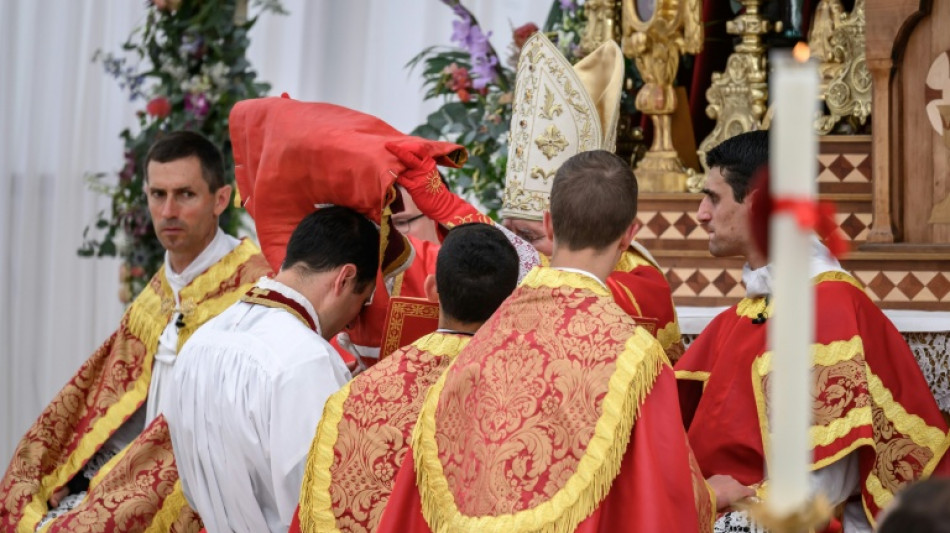
The Society of Saint Pius X, a traditionalist Catholic community, plans to ordain its own bishops on Wednesday without Vatican approval, raising the risk of schism within the Church.
- What is the Society of St. Pius X? -
Founded in 1970 in Econe, Switzerland, by the French bishop Marcel Lefebvre (1905-1991), the group follows a stricter interpretation of doctrinal and liturgical tradition.
It received significant media attention in 1988 after illegally ordaining four bishops, resulting in immediate excommunication.
The Society has a presence in nearly 80 countries and is "well established" in France, Switzerland and the United States, according to Martin Dumont, Secretary General of the Institute for Research on the Study of Religions.
It has 730 priests and more than 260 seminarians today and approximately 600,000 members, Dumont told AFP.
Rejecting outright the changes within the Church since the Second Vatican Council in the 1960s, it defends a traditional patriarchal model of society and an ideal of a theocratic state.
Although influential in certain conservative circles, it remains a minority within the Catholic Church and its approximately 1.4 billion faithful.
- What is the pre-Vatican II rite? -
This rite, codified in the 16th century and known as the "Tridentine" rite, is characterised by the use of Latin, a highly codified and symbolic liturgy.
It is celebrated with the priest facing the altar and his back to the congregation.
The Second Vatican Council (1962-1965), which ushered the Church into modernity, introduced mass in different languages and encouraged the participation of the faithful.
For the Society of Saint Pius X, these reforms represent an alteration of tradition.
- What is the disagreement about? -
On Wednesday at 9:00 am, the new bishops are expected by organisers to be ordained in front of several thousand faithful.
The open-air ceremony, which is due to last several hours, will be held at Econe, the very spot where Lefebvre consecrated four bishops 38 years ago.
For the Vatican, consecrating a bishop without the Pope's approval is a direct act of insubordination.
Such a move, entails the automatic excommunication of the bishops involved and constitutes a "schismatic act".
- Broader excommunication? -
"It's complicated because they're putting Pope Leo in a difficult position," Dumont said.
"He's concerned about not making things worse, about healing wounds... but he's also obliged to take action."
The historian also noted that the Society risks "cutting itself off from potential allies within the Church" at a time when "bridges were beginning to be built".
- How have recent popes reacted? -
The 1988 excommunication was lifted in 2009 by Pope Benedict XVI.
And his successor, Francis, reinstated the validity of confessions and marriages celebrated by priests of the Society in 2015.
Leo XIV also extended an olive branch to traditionalists last October by celebrating mass in Latin in St. Peter's Basilica in Rome, even though Francis had severely restricted this tradition.
- Why now? -
The Society says naming new bishops is a "necessity".
It currently has only two active bishops, which limits its capacity for growth.
It says it has asked the pope for permission to proceed with new ordinations, without receiving a satisfactory response.
But Dumont said there are also internal disagreements between more radical members of the Society and others who favour greater dialogue with the Vatican.
Faced with a new pope whose decisions the Society's leaders may disapprove of, "it is very clear that they are establishing a power dynamic", he said.
The Vatican, for its part, is trying to avoid a rupture.
In mid-June, Leo XIV said he was "saddened" by this decision, specifying that he intended to issue a new "appeal" before the deadline.
V.Vincent--JdCdC