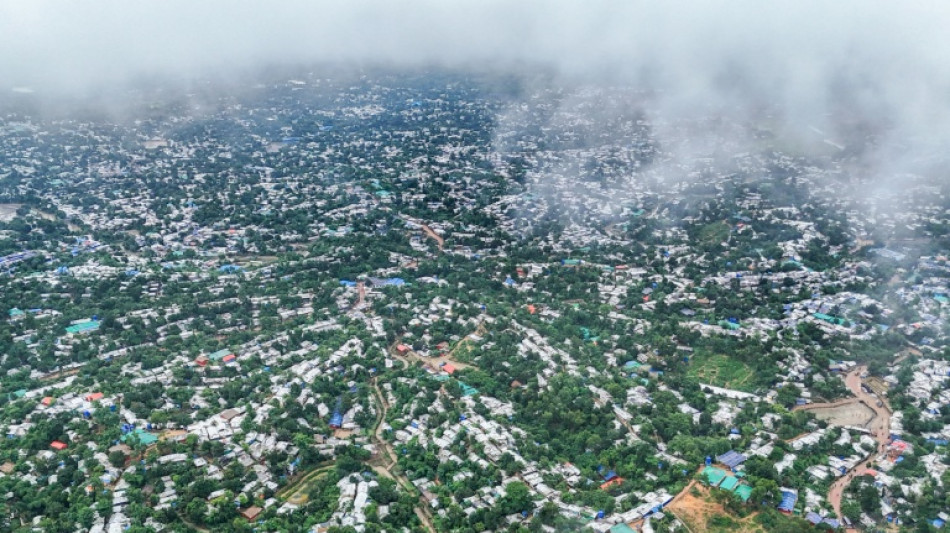
Rohingya refugees protest dire conditions in Bangladesh camps / Photo: Munir UZ ZAMAN - AFP
Tens of thousands of Rohingya refugees in Bangladesh's sprawling camps protested against dire conditions on Tuesday, as they marked nine years since a military crackdown drove them out of neighbouring Myanmar.
More than 1.2 million Rohingya refugees, many of whom fled Myanmar during the brutal crackdown in 2017, live in about 30 overcrowded camps in Bangladesh's Cox's Bazar, the world's largest refugee settlement.
Refugee group the United Council of Rohingya (UCR) said it organised the rally to "remember the atrocities committed" and highlight the "ongoing humanitarian crisis".
Sabikunnahar, 32, who fled to Bangladesh in 2017, said memories remained painful.
"Beheading our near and dear ones, setting fire to our homes and evicting us from our land -- the military occupied our land around nine years ago," she said.
"On this day, my heart gets torn apart. Look at my eyes -- they are still wet with tears for my country."
Conditions in the camps have deteriorated with funding cuts and reduced food rations, aid agencies say. Children make up more than half the population.
"An entire generation of children is growing up in exile," said Golam Mostofa, who heads the charity Save the Children in the camps.
"Yet instead of seeing progress towards safety, rights and a lasting solution, families are facing worsening hunger, fewer opportunities and deepening uncertainty about their future," he added.
One in three refugees is expected to face "crisis" hunger levels or worse between September and December, according to Save the Children.
- 'No hope' -
Moulovi Abdus Salam, 41, who arrived in Bangladesh last year, said his family fled after gunmen "raped our women, killed my brothers and looted my shop".
Salam said life in Bangladesh has brought new hardships, with food rations covering "a maximum of 20 days".
"We don't want the life of a refugee," he said, questioning whether a proposed repatriation process would guarantee Rohingya rights and safety.
"My request to the international community is to create the conditions for us to return home."
Growing desperation has driven some refugees to attempt dangerous sea journeys.
Sikandar, 75, who arrived in Bangladesh in 2017, said there was "no hope" of a safe return to Myanmar.
"They tortured us, raped our women and killed many of our relatives," he said.
"There is no hope for us to return home. There are no realistic plans that can be implemented."
"It's hard to live in a camp. None of us is living here comfortably -- not a single one of us."
Sikandar said humanitarian aid was insufficient, including food provided by the World Food Programme and healthcare from other organisations.
Bangladeshi authorities say they are already overstretched and have called for the dignified return of the Rohingya to their homeland.
The 2017 Myanmar crackdown, which saw Rohingya villages burned and civilians killed, is the subject of a genocide case at the UN's top court in The Hague.
In a joint statement published by the British High Commission in Bangladesh on Tuesday, diplomatic missions in the country said the conditions in Myanmar did not allow for safe repatriation of the refugees.
"Rohingya refugees have a right to return to their homes in Myanmar," the statement said.
"Regrettably, conflict is escalating across Rakhine and humanitarian need is rising. Deepening insecurity, airstrikes on civilian infrastructure and the Myanmar authorities' blockades on aid and trade are worsening the humanitarian crisis."
F.Francois--JdCdC