Anti-immigration protesters force climbdown in Sundance documentary / Photo: Andy Buchanan - AFP
When immigration officials came to arrest two men targeted for deportation, a community sprang into action to protest what they said was a brutal policy by an inhumane government.
With little more than cellphones and a righteous sense of injustice, a handful of people spread the word that they needed to take a stand.
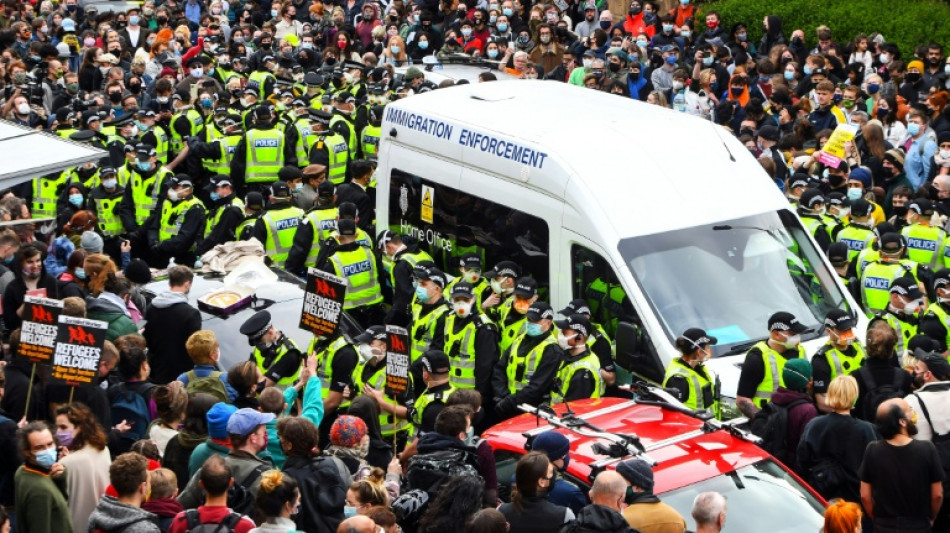
Dozens, then hundreds, then thousands more arrived to confront the authorities to stop their neighbors being taken away.
But this was not Minneapolis in 2026 -- it was Scotland's Glasgow in 2021. The community effort worked; the men were released.
"Everybody to Kenmure Street" was perhaps the most timely documentary at this year's Sundance Film Festival.
Director Felipe Bustos Sierra pieced together the events using cellphone footage from some of the estimated 2,500 people who answered the call from WhatsApp groups, book club text message circles or Facebook livestreams.
What emerged was an uplifting portrait of a spontaneous, organic and leaderless protest in Pollockshields, an ethnically diverse suburb of Glasgow.
- 'Drip, drip, drip' -
Tabassum Niamat had been up all night preparing a family feast for Eid al-Fitr, the celebration that marks the end of the Muslim holy month of Ramadan.
"Suddenly, I got these text messages," she told AFP. "I made my way to Kenmure Street, and lo and behold, what was in front of me was a big immigration van."
A dawn raid on the first day of Eid by a team from Britain's Home Office (interior ministry) seemed designed to inflame tensions in an area with a large South Asian population.
One quick-thinking campaigner crawled underneath the van as the arrests were happening inside a home -- a place he would remain for over eight hours to prevent the van moving.
"It was just maybe five of us at that point. And soon after, there was 10, then it was 20...just like drip, drip, drip, until there were so many of us I couldn't see one end of Kenmure Street to the other," said Niamat.
A growing police presence did not deter the protesters, who set up a makeshift pantry in a bus stop offering food and drinks.
The local mosque also threw open its doors to allow anyone -- police officers or protesters -- to use the toilets.
"What do you do when guests arrive at your doorstep? You feed them, you look after them," Niamat said.
As news of the protest spread, a local human rights lawyer arrived and was able to negotiate the detainees' unconditional release. No one was seriously injured in the spontaneous protest.
- Van man -
Many of the locals who told the story of the protest appeared on camera, but some key characters did not.
Among them was the figure dubbed simply "Van Man," whose name was not revealed, but whose words were spoken by actress Emma Thompson, appearing to be lying under a van.
Partly, explained Bustos Sierra, this was to safeguard a person who became something of a legend around Glasgow after the protest.
But it was also an effort to emphasize that this protest was a collective action, and a victory for everyone.
"Van Man had the opportunity," Bustos Sierra told AFP.
"Anybody could have done this. Anybody should do this. It's the only way we move forward."
The documentary premiered at Sundance two days before 37-year-old protester Alex Pretti was shot dead by US federal agents in Minneapolis as he demonstrated against a military-style immigration crackdown in the city.
While the context was different -- UK police are not routinely armed, and there were no signs in the film that pepper spray or batons were used on protesters -- Niamat saw parallels with Minnesota.
"If you come out for your fellow man, if you come out for the sake of humanity, if you come out because you believe what's happening is wrong, you're instantly going to feel connected, and you'll want to stand together."
The Sundance Film Festival runs until February 1.
L.Richard--JdCdC