Mediators to 'fragile' US-Iran truce urge restraint as violations reported / Photo: - - AFP
The mediators of a fragile US-Iran ceasefire urged all sides Wednesday to respect the truce as Gulf states endured attacks and Israel launched a massive bombing of Hezbollah strongholds in Lebanon.
Washington and Tehran both claimed victory after agreeing to a two-week ceasefire and negotiations aimed at ending a war that has killed thousands across the Middle East and sparked global economic upheaval.
The high-stakes talks in Pakistan this Friday come after Iran agreed to temporarily reopen the Strait of Hormuz under threat of annihilation by President Donald Trump, with ships passing through the strategic waterway on Wednesday.
But the truce remains tenuous, with Iran's powerful Revolutionary Guards warning Wednesday that their "finger is on the trigger" and Pentagon chief Pete Hegseth vowing US forces also remain at the ready.
Pakistani Prime Minister Shehbaz Sharif, whose country mediated the ceasefire, said Wednesday that violations between the United States and Iran "have been reported" and pressed countries to respect the truce.
"I earnestly and sincerely urge all parties to exercise restraint and respect the ceasefire for two weeks, as agreed upon, so that diplomacy can take a lead role towards peaceful settlement of the conflict," Sharif said on X.
Iranian state media reported that Foreign Minister Abbas Araghchi, in a call with the commander of Pakistan's armed forces, had accused Israel of "violations of the ceasefire in Iran and Lebanon".
Israel has insisted the truce does not apply to Lebanon, where it launched a ferocious surprise attack on Beirut on Wednesday targeting the Iran-backed armed group Hezbollah.
The airstrikes -- among the heaviest since the war began -- killed dozens and wounded hundreds more, Lebanon's government said, as people fled in panic and traffic clogged the streets.
More than 1,500 people have been killed in Lebanon since Israel launched airstrikes and a ground invasion in early March, local officials said.
Further underscoring the precarity of the truce, Iranian state media announced fresh "missile and drone attacks" Wednesday on US-allied Gulf states the UAE and Kuwait in retaliation for airstrikes against its oil facilities.
Kuwait said its oil facilities and power and desalination plants were damaged in "an intense wave" of strikes that lasted hours.
The UAE said it was targeted with 17 Iranian missiles and 35 drones since the ceasefire took effect, Saudi Arabia intercepted nine drones and Bahrain said its capital Manama came under attack.
- 'Fragile truce' -
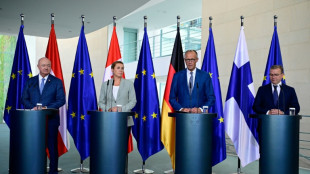
On Wednesday, the leaders of several European nations, Canada and the UK said "a swift and lasting end to the war" must be negotiated as Pope Leo hailed a moment of "real hope".
But Tehran's demands over uranium enrichment, economic sanctions and future control over Hormuz -- a narrow strait through which one-fifth of the world's oil passes -- are deeply at odds with the United States.
US Vice President JD Vance, speaking during a visit to Budapest, urged Iran to come to the table in "good faith" but warned Trump was "not one to mess around".
"If they're going to lie, if they're going to cheat, if they're trying to prevent even the fragile truce that we've set up from taking place, then they're not going to be happy," he said.
Trump told AFP the ceasefire was a "total and complete victory" for the US. Iran also hailed it as a win but warned it "does not mean the end of the war" unless its terms were met.
Israel had encouraged Trump to launch the war against Iran, its arch-foe, according to a report in The New York Times.
A peace agreement would leave in place the Islamic republic despite US and Israeli hopes of toppling it. The United States and Israel said they attacked Iran to degrade its military capacity.
The White House said Israel had agreed to the ceasefire. But even before Israel said the truce would not include Lebanon, a diplomat with knowledge of the talks had told AFP "there are real fears that Israel may derail the truce or any deal".
Their announcement has confirmed these fears, they said, adding that Israel's "objectives in the war are different to that of their US ally".
- Tehran quiet -
In Tehran, streets were quieter than usual on Wednesday, with many shops closed after a long and anxious night for city inhabitants fearing a massive US attack.
Trump had earlier warned a "whole civilisation will die" in Iran if the Strait of Hormuz was not opened by midnight GMT, but said he held off after speaking with Pakistan's leaders.
Araghchi confirmed safe passage for two weeks for ships through the strait, which Tehran sealed off in retaliation for the war, sending global energy prices soaring.
A Greek-owned bulk carrier and a Liberia-flagged vessel were the first to sail through Wednesday since the ceasefire began, said the maritime monitor Marine Traffic.
Trump posted Wednesday on social media that the US would "be helping with the traffic buildup in the Strait of Hormuz".
Oil prices plunged by more than 17 percent after the ceasefire announcement, while European natural gas dropped 20 percent.
Trump said the United States was "very far along" in negotiating a long-term agreement with Iran, which had submitted a 10-point plan that he said was "workable".
But Iran publicly released points that took maximalist positions, including lifting long-standing US sanctions, guaranteeing Iranian "dominion" over the strait and removing US forces from the region.
Crucially, it also said its plan would require Washington to accept its uranium enrichment programme.
A US official later said the 10-point plan published by Iran was not the same set of conditions agreed by the White House for pausing the war.
Trump has alleged that Iran was close to an atomic bomb, an assertion not backed by the UN nuclear watchdog and most observers.
On Wednesday, Trump said there would be no enrichment of uranium by Iran, while Hegseth said Tehran would either give it up or the US would "take it out".
burs/np/jsa
L.Leclerc--JdCdC