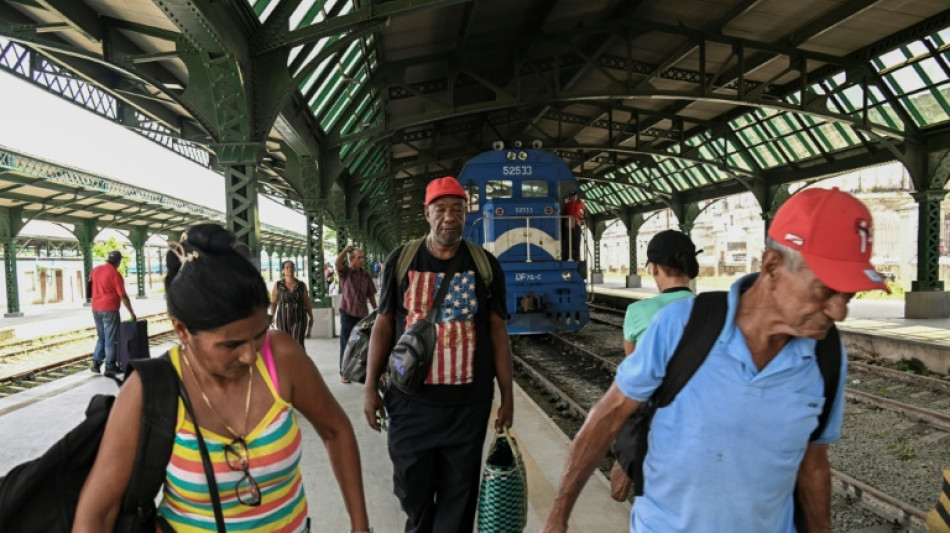
Drastic restrictions on public transport take effect in Cuba / Photo: YAMIL LAGE - AFP
Drastic restrictions on cross-country travel took effect Thursday in cash-strapped Cuba, with spaces on ever scarcer trains and buses now reserved for the sick, people traveling for funerals and other emergencies.
Cuba has been running on empty since the United States in January cut off its fuel imports as part of a pressure campaign aimed at forcing changes to the communist island's economic model, if not its leaders in Havana.
Transport across the island, which was already reeling from the worst economic crisis in memory, has screeched to a near halt as petrol pumps run dry.
From Thursday, trains from the capital Havana to cities in the east will only run every 16 days - compared to around three times a week previously.
Public buses, which used to run at least once daily to provincial cities, will only operate one to three times a week.
Deputy Transport Minister Luis Ladron de Guevara emphasized that no permits were needed to travel but that a "priority system" would operate.
Passengers are required to apply seven days in advance for passage.
Cuba has vowed to resist the US pressure while announcing reforms to attract investment and compensate for the flight of foreign capital.
- Lives on the line -
The restrictions on inter-city transport affect state-run transportation, on which most Cubans depend.
While small numbers of private taxis and buses continue to serve other cities, they are prohibitively expensive -- up to 200 times the price of the state alternative.
Outside a state-run bus office in Havana, 51-year-old Madelaine Montero was waiting on Wednesday for a ticket to take her father, an 80-year-old cancer patient, home to Granma, some 750 kilometers (466 miles) away in the east.
She told AFP he needed to be home 20 days before his next check-up to undergo tests, "otherwise he can't receive treatment."
A few meters away, 60-year-old Jose Manuel Garcia, who is blind in one eye and undergoing treatment for retinal detachment to save the other, was seeking passage home to the city of Santiago de Cuba.
He said he feared having to suspend treatment -- available only in Havana -- if getting there proved "so difficult" each time.
- 'Staying home' -
In Havana, too, municipal buses have virtually disappeared, leaving most people with no option but to walk to work or school in near 40C heat.
With fuel trading hands at around $8 per liter on the black market, even a short taxi ride can swallow most of a civil servant's wages.
"With prices so high...people are staying home," said Julio Cesar Padron, the 30-year-old driver of a Chevrolet truck which he has repurposed as a 40-seater bus.
On Wednesday, dozens of people stood on the side of an eight-lane highway leading east out of the capital trying their luck by waving fistfuls of bills at passing vehicles.
Alexi Martinez, a 56-year-old public health worker, spends almost all her salary on truck tickets to visit her elderly diabetic mother in Havana.
She sees no alternative.
"I have to do it because I'm an only child."
V.Vincent--JdCdC