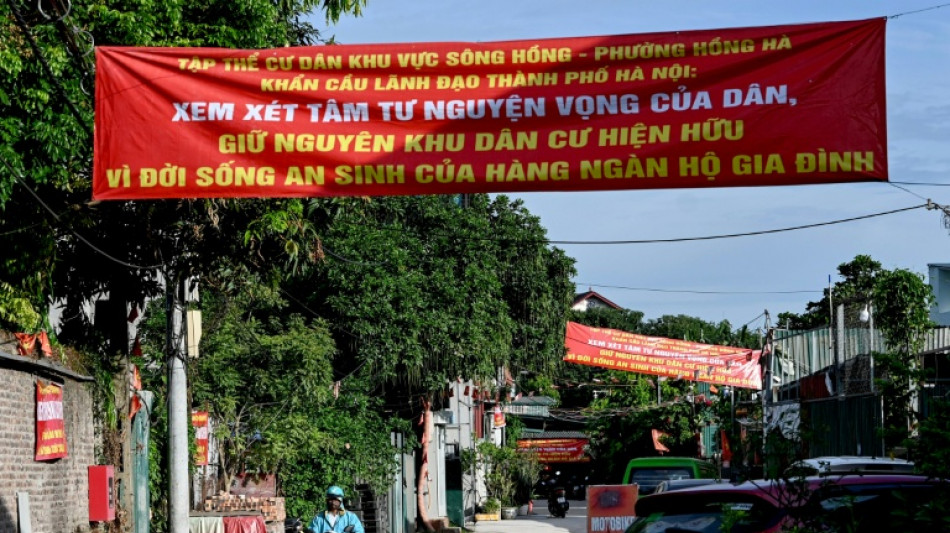
Hanoi residents mount silent protest over home demolitions / Photo: STR - AFP
Silent prayer vigils, cautiously worded protest banners and T-shirts pleading for neighbourhoods to be spared -- Hanoi residents are showing rare public opposition to a massive redevelopment scheme that could displace hundreds of thousands.
Authorities in Vietnam's capital have been on a demolition blitz, knocking down thousands of homes to make way for bridges and other infrastructure projects as part of a 100-year master plan approved last month.
One 11,000-hectare area along the Red River -- roughly the size of Paris -- is slated to become a warren of high-end residential complexes and parks, with roughly 250,000 residents relocated.
Large-scale protests are rare in Vietnam, where the communist authorities brook little dissent.
But private grumbling has given way to tentative public opposition as residents fight to save their homes.
"We have been living in fear, we don't know when we will be kicked out of our houses. We want our voice to be heard," said Hoa.
Her life savings are tied up in a two-storey house in the planned development area, surrounded by ornamental and fruit trees.
Last week, she joined a vigil at a Buddhist temple where residents prayed for peace -- a veiled plea for their homes to be spared.
Hundreds of Red River area residents have attended similar vigils, organised anonymously in recent weeks and publicised on social media.
The low-lying region is home to dozens of vibrant communities, some dating back centuries with bustling markets, leafy gardens and traditional burial grounds.
French-style villas stand to be bulldozed, along with modest Hanoi-style "tube" houses and densely packed low-rises.
"May the Buddhas of the ten directions hear our earnest plea," one anonymous user commented on a Facebook group dedicated to the Red River redevelopment.
"Please help us avoid losing our homes, our land, our ancestral graves."
- Cautious -
Not far from Hoa's home on a nearby street, resident Duc said he and some neighbours hung a banner from the balcony of his four-storey home.
"We urge local authorities to consider people's aspiration in maintaining the present communities," it read.
He said the phrasing was deliberately cautious, "avoiding strong words like 'protest' or 'against'", but that the authorities nonetheless asked him to take it down.
Dozens of similar banners have appeared on nearby houses, with many disappearing after a few days.
Tuong Vu, a Vietnam expert at the University of Oregon, said Hanoi residents had "expressed their disagreement and resentment at losing their lands and houses".
Duc said he would wait to see what happened in his neighbourhood before making any more attempts to save his home.
"It's not fair and also a big waste of money," he said of the plan to relocate so many people.
"We really don't want to move."
- Compensation -
Neither do any of the dozen or so women who gathered over the weekend to stroll along the shores of Hanoi's West Lake wearing matching red-and-yellow T-shirts.
Ostensibly there to exercise, the women were also carrying a message on their backs -- a call to maintain the "existing residential area" along the Red River.
Authorities have pledged to compensate residents for their homes and said they will build up to 85,000 new units to eventually house them on the outskirts of the city.
The principle will be that "the new living conditions are equal to or better than the old ones", the city has said.
But many residents already displaced as part of Hanoi's urban renewal drive complain they were paid below-market rates for their homes.
Others question how long the new housing will take to build -- and how they will afford rent in the interim.
In the Red River area, part of the anger stems from the perception that private companies will profit from high-end apartments replacing their homes.
A consortium of three developers is undertaking the $30 billion mega-project as part of a public-private partnership.
In 2020, a dispute over land expropriated to build an airport near Hanoi devolved into clashes that left three police officers and one villager dead, with two protesters later sentenced to death and more than two dozen jailed.
Since then, Oregon professor Vu said "there have been fewer acts of public protest and dissent".
H.Henry--JdCdC