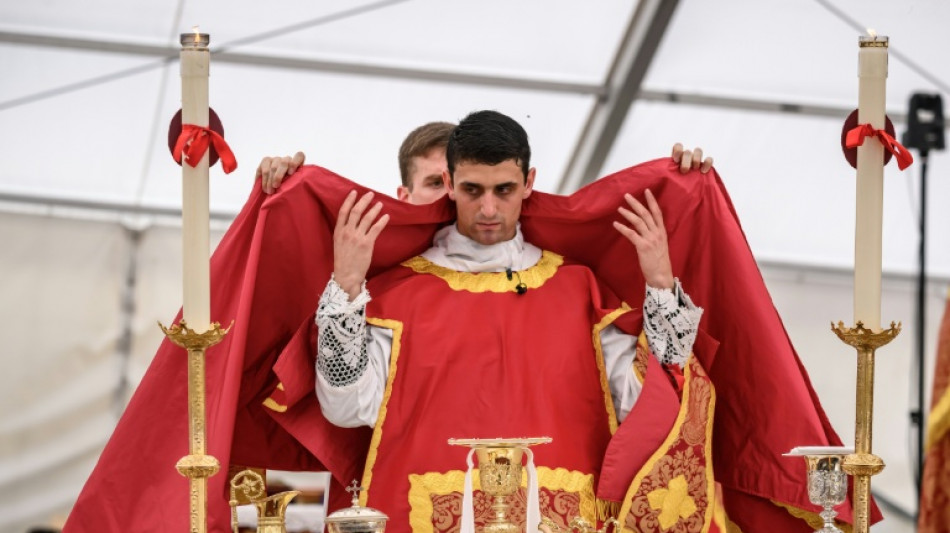
Breakaway Catholic sect defies Vatican again by ordaining bishops / Photo: Fabrice COFFRINI - AFP
Decades after triggering a rift with the Vatican by consecrating bishops in 1988, the Society of Saint Pius X is doing it again on Wednesday in defiance of Pope Leo XIV.
The ultra-traditionalist breakaway group with about 600,000 followers worldwide intends to appoint four bishops: two French, one American and one Swiss.
The ceremony will take place during a mass in Latin lasting around four hours before an expected 15,000-strong congregation in the fields of Econe in Switzerland -- the very spot where the society's founder Marcel Lefebvre controversially consecrated four bishops 38 years ago.
"I plead with you and ask you with all my heart: please turn back!" Pope Leo wrote Monday in a letter to the society, calling it a "schismatic act".
"To tear the seamless garment of Christ is a sin of extreme gravity," the pontiff said.
The Society of Saint Pius X comprises fundamentalist Catholics who strongly oppose the liberal reforms imposed by the Vatican II Council in the 1960s.
The brotherhood was founded in 1970 by Lefebvre, a French bishop.
The new consecrations are set to take place near the society's seminary in Econe, a village in the Rhone valley in Alpine southwest Switzerland, at the foot of the mountains.
"It is not an act of rebellion, it is an act born of love for the Church," Father Michel Rion, a theology professor at the seminary -- one of the society's five worldwide -- told AFP.
As in 1988, the society's future bishops will be consecrated without assigned jurisdiction from Rome, in a situation the group claims precludes any schism or excommunication -- though the Vatican views the matter differently.
- 'We would rather die' -
"There is absolutely nothing schismatic or anti-Church in our actions. We hope that one day the pope will see that. For us, being schismatic is the worst thing that could happen, we would rather die than be schismatic," Rion insisted.
The society says it is present in more than 75 countries across six continents, with more than 750 priests and around 600,000 faithful.
Adhering to a strict interpretation of Roman Catholic tradition, the society holds masses in Latin celebrated by priests with their backs turned to the congregation.
"The Church constantly seeks to adapt -- to adapt its message to lead souls to heaven," but has "adapted too much to the world", said Rion.
For the Holy See, consecrating bishops without the approval of Pope Leo would be a direct act of insubordination, leading to the automatic excommunication of the bishops -- both those being consecrated and those performing the act.
The society's superior-general, Father Davide Pagliarani, said in a statement published Tuesday that the group would go ahead with the consecrations and insisted it was "neither schismatic nor hostile to the Church".
- Only two bishops left -
In 1988, Pope John Paul II issued a similar appeal to that of Pope Leo but failed to stop the society from ordaining bishops. They were immediately excommunicated, but the sanction was lifted in 2009 by Pope Benedict XVI.
His successor, Pope Francis, had, starting in 2015, recognised the validity of confessions and marriages celebrated by the society's priests.
Pope Leo extended an olive branch to them last October by celebrating mass in Latin at St. Peter's Basilica in Rome.
The society sees consecrating new bishops as a necessity, arguing it has only two bishops left.
Although influential in certain conservative circles, it remains a minority group within the Roman Catholic Church and its roughly 1.3 billion faithful.
M.Muller--JdCdC