As election looms, Netanyahu puts Turkey in Israel's crosshairs / Photo: JACK GUEZ - AFP
After more than two years of ordering on Israel's enemies across the Middle East, Prime Minister Benjamin Netanyahu, facing a tough re-election fight, is zeroing in on another perceived villain -- Turkey.
On Tuesday, Warplanes bombed a base in northern Syria a short drive from the Turkish border.
Netanyahu said Turkey was looking to establish a military presence there and that, after after it ignored Israel's warnings: "We made sure they understood it more clearly."
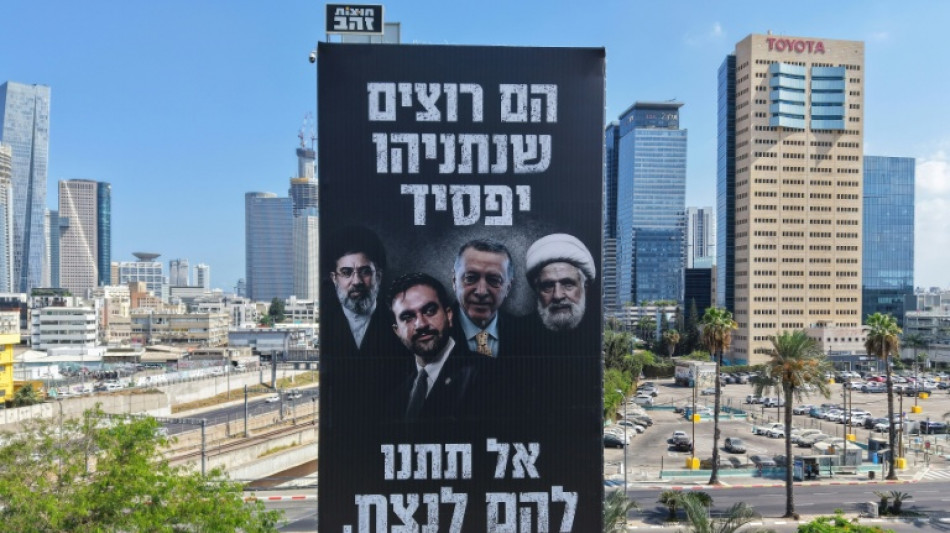
Heading into the October 27 election, Netanyahu's campaign has put up billboards with images of several leaders including Turkish President Recep Tayyip Erdogan, with the caption: "They want Netanyahu to lose."
Erdogan has been a virulent critic of Israel's massive offensive in Gaza since the unprecedented October 7, 2023 attack by Hamas. Relations have deteriorated over Israel's aggressive interception of activist flotillas from Turkey seeking to force aid into Gaza.
But unlike other countries attacked by Netanyahu such as Iran, Turkey has powerful allies. It is a member of NATO and Erdogan enjoys a warm relationship with US President Donald Trump, whose ambassador to Ankara condemned Israel over the strikes.
Turkey's relationship with Israel is also not without nuance. Turkey was the first Muslim-majority country to recognise Israel and the countries once had robust trade, although Turkey during the Gaza war said it would halt all business with Israel.
Yair Golan, leader of Israel's centre-left opposition Democrats, called the attack in Syria "provocative and dangerous", warning it "brings us closer to a confrontation with Turkey and deepens the rift with our allies, chief among them the United States".
"Once again, military force is being employed for political considerations, and once again Israel pays the price in security," Golan said.
- Wide suspicion of Erdogan -
Erdogan, who has allowed Hamas leaders to live in Turkey, also has plenty of Israeli critics outside the prime minister's circle. Centre-right opposition figure Naftali Bennett, a former prime minister, earlier this year accused Netanyahu of ignoring "a new Turkish threat" by focusing only on Iran.
Gallia Lindenstrauss, a senior research fellow at the Tel Aviv-based Institute for National Security Studies, said that Erdogan's uncompromising language did little to ease Israeli concerns.
"There are also worries that, like how Turkey hosts Hamas, it might allow militant groups to operate inside Syria that might present in the future a threat to Israel," she said.
But she noted that Israel, which has created what it calls a security zone in southern Syria, has generally accepted Turkish interests in the north.
"You see Netanyahu using the anti-Turkish card. I think he sees it as something that can maybe unify his base around him," Lindenstrauss said.
Netanyahu faces opposition charges he has not achieved the goals of his myriad wars such as toppling Iran's Islamic Republic or destroying Hamas, said Gonul Tol, a senior fellow at the Middle East Institute in Washington.
In the United States, while Erdogan has plenty of detractors, any more direct action against Turkey risks making Netanyahu look like "a reckless leader who would do anything to cling to power", Gol said.
"If he crosses that threshold, I think he must understand that it's not going to be good for him because you also have the Trump wild card, and Netanyahu cannot count on his support," she said.
She saw Turkey's denial of the Israeli allegations as a way to dial down tensions.
"Erdogan being a populist leader, he could have just jumped on the bandwagon and said, we are going to attack, we will retaliate, and yet he did not do that," she said.
- Syria in middle -
Turkey's interests in Syria historically revolved around preventing a spillover of Kurdish fighters.
But its priority now is to revive Syria's economy so refugees can return and also to foster a strong regional ally at a time when Greece, Cyprus and Israel are countering Turkey in the Eastern Mediterranean, Tol said.
Turkey has championed Syrian President Ahmed al-Sharaa, a former Sunni jihadist whose rebels in late 2024 ousted longtime ruler Bashar al-Assad, ending a brutal civil war.
For Syria, the challenge is not to become an arena for others' conflict, said Maher Tamran, a writer and political researcher in Damascus.
"It must capitalise on the Turkish-Israeli rivalry to reclaim Syrian sovereignty," he said.
Both Turkey and Israel "agree on the stability of Syria, but diverge on the definition of stability itself."
V.Vincent--JdCdC