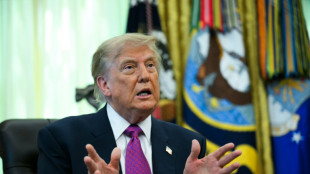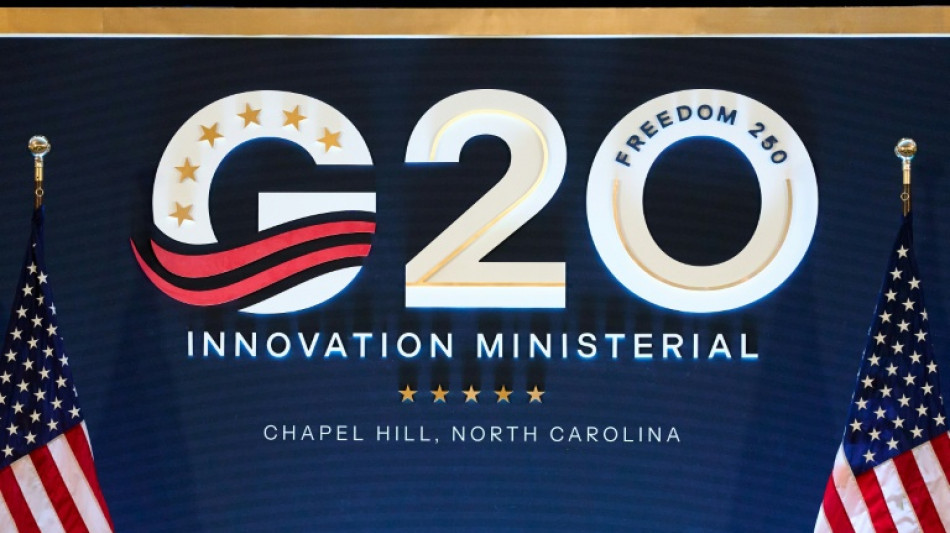
Europe, US closer than they look on tech rules, says EU tech chief / Photo: Matt RAMEY - AFP
EU tech chief Henna Virkkunen on Wednesday played down the regulatory gulf between Brussels and Washington, arguing that US courts end up policing the same companies for the same behavior that European law targets in advance.
"The differences are not so big when we look at it in practice," the European Commission's executive vice-president for tech sovereignty told AFP on the sidelines of a G20 meeting of technology ministers in North Carolina.
"In Europe, we have regulation in advance, and in the USA they are often coming with the court cases," she said. "The same companies, the same practices, are under investigation and under discussion."
Her remarks came after two days of sessions in which the ministers were addressed by industry figures including Nvidia's Jensen Huang and Elon Musk, who used the platform to repeat the familiar charge that Europe over-regulates technology.
Virkkunen said she did not accept the premise.
"We don't see -- and I don't see -- that innovation and regulation are opposite things," the Finnish official said.
She pointed to a recent Eurobarometer survey published in which 80 percent of European respondents said careful regulation of AI was important for safety reasons.
"For Europeans, it's important that we can trust these technologies," she said, while acknowledging that Brussels would bring forward proposals to streamline some EU rules.
She noted that the absence of national tech laws in the United States has not left the industry free of government rules there.
"At (the) state level, there are hundreds of rules now on AI (in the US)," she said. "That is the situation we wanted to avoid with our AI Act -- that we have one rule for the whole market."
Virkkunen said the convergence between Europe and the United States could be seen most clearly in attitudes toward protecting minors on social media.
Meta last month reached a landmark settlement with nearly every US state, promising curfews and time limits for teens on Instagram and Facebook.
Asked about the settlement, she said some of its provisions were already law in Europe under the Digital Services Act, which requires platforms to let users flag illegal content and choose the recommender system that serves them.
But she said Brussels was pursuing the same underlying concerns about how addictive the platforms can be -- an issue that has seen Meta, YouTube and TikTok face thousands of lawsuits in the United States.
The Commission published preliminary findings in July on the addictive design of Meta's services, and earlier in the summer on how the company checks whether a user is at least 13 years old.
It has also issued preliminary findings against TikTok on addictive design and opened an investigation into Snapchat in the spring.
"We are ready to come up with stronger rules also in Europe on this matter, but I think social media platforms could also do much more now already," Virkkunen said.
- 'Comply on AI' -
On AI safety, she said the enforcement powers attached to the EU's AI Act took effect in August, and that most leading AI developers had been cooperating with the Commission voluntarily before then.
"They understand that if they want to operate in the European markets, we have our rules and they have to comply with our rules," she said.
Asked whether Europe was seeing the kind of local opposition to data centers now spreading in the United States, Virkkunen said the debate was already lively in some EU member states -- an outcome she said careful planning was meant to avoid.
She described an imbalance within the bloc, with data center builders gravitating toward countries with abundant cheap clean power.
"It's not a good solution if they are just located in some countries in Europe," she said. "We need them in all countries because they are a very important part of our digital infrastructure."
P.Philippe--JdCdC