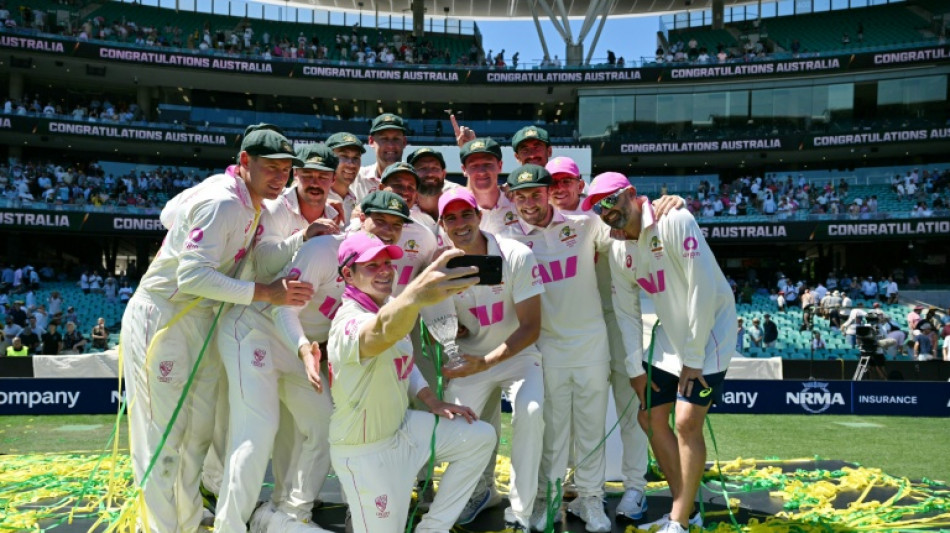
Death of Bazball: Five things we learned from Ashes series / Photo: Saeed KHAN - AFP
Australia sealed a thumping 4-1 Ashes win over England with a five-wicket victory in the final Test at Sydney on Thursday.
AFP Sport looks at five key takeaways from the series:
- Death of Bazball? -
England came to Australia with genuine hopes of a first away Ashes series win since 2010-11 with their aggressive "Bazball" approach.
But it quickly unravelled on treacherous batting pitches and in the face of consistently good Australian bowling.
They slumped 2-0 down after just six days of cricket with crushing eight-wicket defeats in Perth and Brisbane, and the knives came out for coach Brendon McCullum and captain Ben Stokes.
Former England skipper Michael Vaughan said the gung-ho style was "all becoming a bit too predictable" while long-time BBC broadcaster Jonathan Agnew declared "Bazball is dead."
When Stokes spent more than four hours defying Australia in the first innings of the third Test in reaching his slowest-ever 50 it appeared that the Bazball brand of attacking cricket may well have fizzled out.
- McCullum to face music -
McCullum leaves Australia with serious questions over whether he should keep his job, although Stokes is almost certainly safe.
Head of cricket Rob Key will also have to face the music for a tour marred by claims that England were under-prepared and lacked discipline, with a mid-series beach break and drinking session heavily criticised.
Stokes has urged England chiefs to keep faith with New Zealander McCullum, warning against knee-jerk changes.
"I can't see there being someone else who I could take this team (with) from where we are now to even bigger heights," he said.
"We're both pretty keen on carrying on doing what we are doing."
- Head-spinning -
Australia lost one long-established opener but found another.
When Usman Khawaja suffered back spasms in the first Test at Perth, Travis Head was promoted from five and slammed a rapid-fire match-winning 123.
He stayed at the top of the order for the rest of the series, crunching further swashbuckling centuries in Adelaide and Sydney, with his position now seemingly cemented.
The 39-year-old Khawaja made a successful comeback in the third Test at number four for the injured Steve Smith, but the writing was on the wall and he announced his decision to retire after his 88th Test in Sydney.
Head's opening partner Jake Weatherald failed to fire, with selectors still searching for a settled top two more than two years since David Warner called it quits.
- Australia depth -
Australia's superior bowling depth was on full display during the series, with even a depleted attack able to wrestle England into submission.
Injured pace spearhead Josh Hazlewood played no part at all while Pat Cummins was only able to don the Baggy Green in Adelaide and regular stand-by Sean Abbott was also unavailable.
It was left to the evergreen Mitchell Starc to carry the load and he was ably supported by Scott Boland throughout, with Brendan Doggett, Michael Neser and Jhye Richardson all playing their part.
Stokes admitted they were outplayed by Australia's attack, crediting their "amazing execution" with the ball as key to the series result.
"There's a big difference between what Australia have been able to do with the ball compared to what we've been able to," he said. "We own that."
- Class tells -
The cream usually rises to the top and once again veterans Joe Root and Steve Smith demonstrated why they are in a class of their own.
Root plundered his first century on Australian soil under huge pressure to finally get the monkey off his back and followed it up with another.
Smith expertly captained Australia in four of the five Tests while blasting his own ton.
With 286 Tests and more than 24,000 runs between them, milestones once again fell.
Root joined Ricky Ponting on 41 Test hundreds with only Jacques Kallis (45) and Sachin Tendulkar (51) ahead of him, while Smith's 13th Ashes ton was more than anyone bar Donald Bradman.
Root, 35, hinted in Sydney he could be back for another tour in 2029, while Smith, 36, has given no indication he is ready to up stumps.
W.Weber--JdCdC