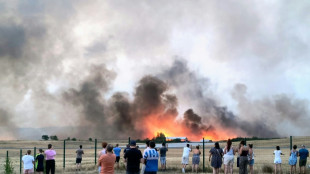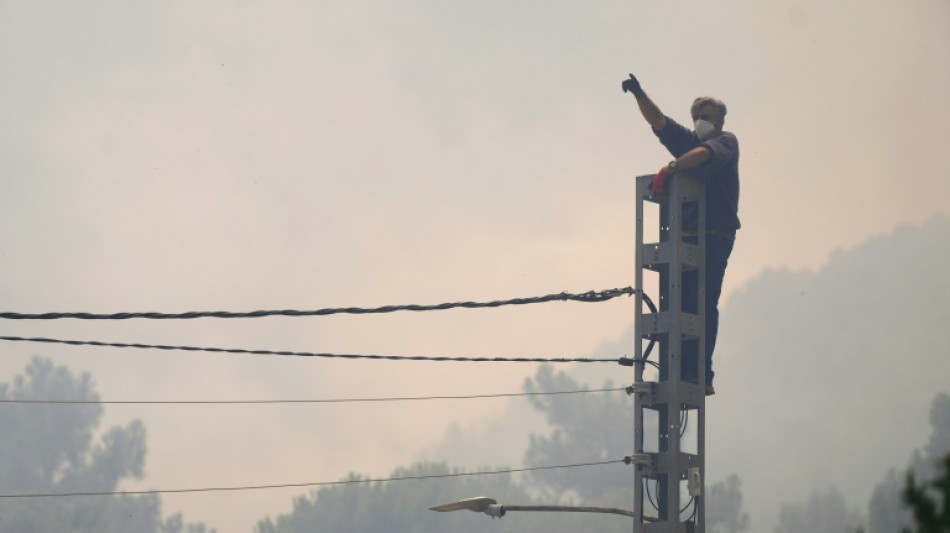
As wildfires grip France and Spain, what are the risks from the smoke? / Photo: Cesar MANSO - AFP
What dangers does smoke from wildfires pose? Who is most at risk? Here are some answers to health questions often asked, especially now with the fires in France and Spain.
What is in the smoke?
Fires burning vegetation generate gas and particles in the air that are dangerous for our systems, notes Anses, France's health safety agency.
Fine particles especially are particularly bad, because they can penetrate deeply into the lungs.
Carbon monoxide is one of the major pollutants released by such fires, the agency says, which listed other chemical substances also, such as carbon dioxide, volatile organic compounds including acrolein, formaldehyde and benzene.
As well as these, other pollutants can be mixed in if vehicles or buildings are consumed by flames.
Who is most at risk?
Individuals closest to a fire can display symptoms of respiratory irritation. But effects will go on to be felt more widely in a population if a wind carries the smoke, over the following hours or several days later, French pulmonologist Bruno Crestani told AFP.
Especially at risk are "vulnerable persons -- those who are old, or who have a respiratory disease, or infants, or asthmatics -- because this (smoke) can unbalance a situation that was previously under control, said Crestani, who heads France's Respiratory Health Foundation.
The impact is "not only respiratory", he pointed out. "These particles can enter the circulatory system" and possibly trigger diabetes, a stroke or a heart attack, he said.
Because these particles are so fine and light, they can end up being carried long distances, to affect people well away from the fire zone.
In September 2025, the World Meteorological Organization stressed that wildfires can send a toxic mix of pollutants thousands of kilometres. It noted that, in 2024, smoke from wildfires in Canada even caused air pollution as far away as Europe.
What specific risks for firefighters?
Anses underlined effects on firefighters, not only as they battled blazes, but also indirectly, as they monitor extinguished areas, carry out investigations and clearing, and also when back in the fire station with contaminated equipment and vehicles.
Other factors could increase their vulnerability, such as smoke inhalation, heat stress, dehydration, strenuous work, sleep deprivation, accumulated fatigue and accidents, the agency said.
How deadly is it?
In December 2025, in its annual report on climate-change risks to health, the medical journal The Lancet estimated that "exposure to wildfire smoke led to an estimated 154,000 deaths" the previous year, worldwide, attributed to fine particulate matter.
For France, the charity Oxfam estimated that there were 2,800 early deaths yearly from air pollution caused by wildfires.
Crestani stressed that the long-term effects needed to be taken into account for the entire population, and not only for vulnerable persons.
How to protect yourself?
French Prime Minister Sebastien Lecornu has promised to send 1.5 million FFP2 masks to the Gironde region where an unprecedented wildfire was blazing, to help protect the population there.
Anses recommends such masks for anyone likely to have trouble when exposed to smoke. And if they experienced breathing problems or other symptoms, they should seek medical help, it says.
"It's not 100-percent protection, but it's useful, yes, to wear a mask," Crestani said.
In zones that have not been evacuated, Anses advised people to limit their time spent outdoors, and to keep windows and doors shut. Any air vents should have wet cloths draped in front, and automatic bathroom ventilation should be turned off.
P.Philippe--JdCdC