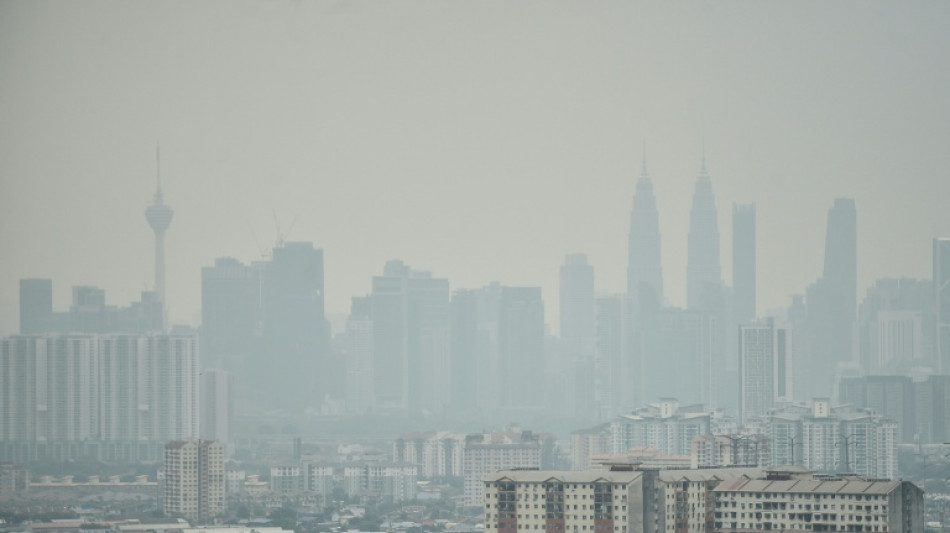
Malaysia's Sarawak eyes cloud seeding as haze worsens / Photo: Arif Kartono - AFP
Malaysia's Sarawak state plans cloud seeding operations in early September, officials said Monday, as smoke from fires in neighbouring Indonesia pushes air quality to hazardous levels.
Indonesia, a vast archipelago, has for weeks battled wildfires that have led to school closures and thousands of people requiring medical treatment, with smoke also drifting across to Malaysia and Singapore.
Sarawak, which shares a border with Indonesia's Kalimantan province on Borneo island, has been the most affected by the haze.
Sarawak Disaster Management Committee chairman Douglas Uggah Embas said Monday cloud seeding could be carried out between September 3 and 5, if weather and atmospheric conditions permit.
"Cloud seeding can only be carried out when suitable cloud formations and atmospheric conditions are present -- it cannot create rain in the absence of suitable clouds," Uggah told reporters.
Air quality deteriorated sharply across Sarawak on Monday, with seven locations recording hazardous Air Pollutant Index (API) readings above 300, led by Serian district at 475.
Under national guidelines, API readings above 300 are considered hazardous, while levels exceeding 500 trigger consideration of a local emergency.
"If an emergency is declared, it will strictly be enforced within that specific locality, not for the entire state," Uggah said.
The cloud-seeding also aims to replenish critically depleted reservoirs and dams after a prolonged dry spell.
State satellite monitoring detected nine active hotspots in Sarawak, compared with 1,180 in Indonesia's Kalimantan region.
Kalimantan recorded 15,587 hotspots between January and late August, including more than 13,000 in August alone.
"This issue is a diplomatic issue," Uggah said, adding that the state authorities had urged the federal government to raise the matter with Jakarta under the ASEAN Agreement on Transboundary Haze Pollution.
Authorities have deployed firefighters to the hotspots in Sarawak and urged residents to limit outdoor activities and wear N95 masks.
The Indonesian fires take place every year during the dry season and this year's fires will be turbocharged by a powerful El Nino -- a naturally occurring climate phenomenon that brings worldwide changes in winds, air pressure and rainfall patterns.
It typically causes drier conditions in Indonesia and is associated with severe fires.
Fires in 2015 were also among the deadliest on record, cloaking Southeast Asia in toxic smoke for weeks and causing many people to become ill, schools to close, and flights to be cancelled.
J.Thomas--JdCdC