What to know about Trump's $5,000 'dividend' pledge / Photo: RONALDO SCHEMIDT - AFP
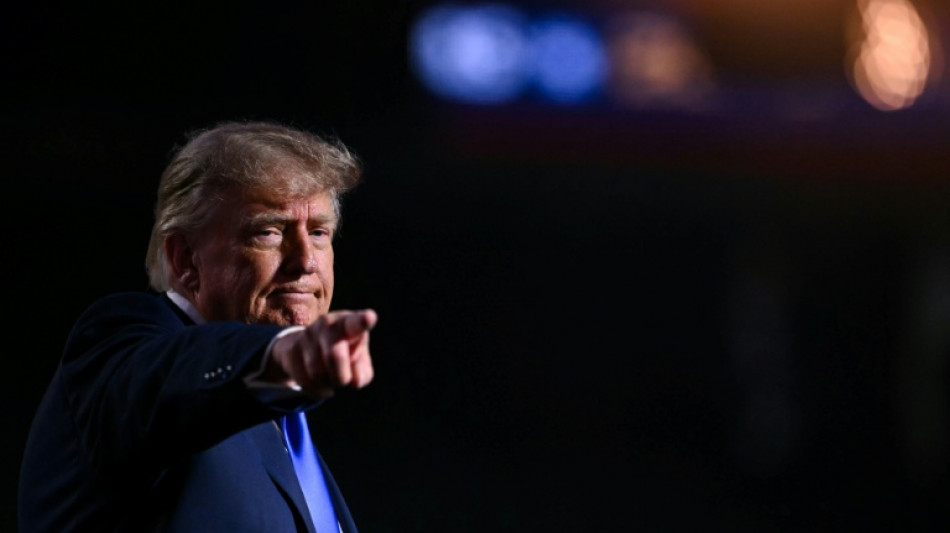
President Donald Trump has promised $5,000 to every American adult if Republicans retain control of the House of Representatives and the Senate in the November midterm elections.
The pledge has raised questions about its legality, its cost and where the money would come from.
- Is it legal? -
Federal law prohibits offering payments in exchange for votes and separately restricts promises of federally funded benefits in return for political support.
Trump's offer would appear to skirt these prohibitions because it is more in the nature of a campaign promise and would apply to all adult Americans regardless of how they voted.
Any such payment would in any case require congressional authorization, as the Constitution bars the president from spending Treasury funds without an appropriation made by law.
Trump has made similar pledges in the past which never came about, including promising Americans $2,000 checks from tariff revenues and $5,000 checks from savings made from drastic federal job cuts.
- How much would it cost? -
There are about 276.8 million adults aged 18 and over in the United States in 2026, and doling out $5,000 to each would come to $1.384 trillion.
Trump said he was targeting "every American." Restricting the payments to US citizens would reduce that figure to about $1.27 trillion.
During the Covid pandemic, Congress approved payouts to income-eligible tax filers and their dependents only, a narrower approach that would lower the cost further.
The three rounds of pandemic stimulus checks approved in 2020 and 2021 came to about $814 billion in total, according to federal oversight data.
- Would the checks make inflation worse? -
Almost certainly. This a serious problem for Trump as he faces voter anger over the cost of living.
Direct cash handouts of this kind are sometimes described by economists as "helicopter money" -- a term for no-strings-attached payouts from a central bank, meant to jolt an economy out of deflation, the opposite of the price pressures the United States faces now.
US consumer inflation is running at 3.4 percent, well above the central bank's two percent long-term target. So injecting roughly $1.27 trillion into consumer hands would stir demand in an economy where prices are already rising, partly because of the energy shock from the Iran war.
Research published by the Federal Reserve Bank of St. Louis estimated that pandemic-era fiscal stimulus, which also included support for businesses, added about 2.6 percentage points to US inflation.
- Could tariff money pay for Trump's new promise? -
Not anytime soon. The government collected a record $195 billion in customs duties in fiscal 2025, meaning a $1.4 trillion payout would consume roughly seven years of revenues from Trump's trade policies.
Moreover, the Supreme Court struck down Trump's signature tariffs in February, forcing the US Treasury to refund importers with interest, and net customs revenue turned negative in May through July.
- 'Corrupt' and 'Reckless' -
Democratic reaction to Trump's proposal was withering.
California Governor Gavin Newsom, a potential 2028 Democratic presidential candidate, condemned the pledge as coming from "the most corrupt man ever to occupy the Oval Office."
"After making you sicker and poorer with his war, Donald Trump now wants to buy your vote with $5,000 in taxpayer-funded blood money," Newsom said on X.
Representative Jamie Raskin, a Democrat from Maryland, said Trump's pledge was just the latest move in a "fantastically reckless and dysfunctional presidency."
"So after adding trillions of dollars to the national debt, driving it over an unprecedented $40 trillion, Trump now offers everyone a $5,000 political bribe ("the Trump Dividend") if we elect Republicans to run Congress," Raskin said.
C.Caron--JdCdC