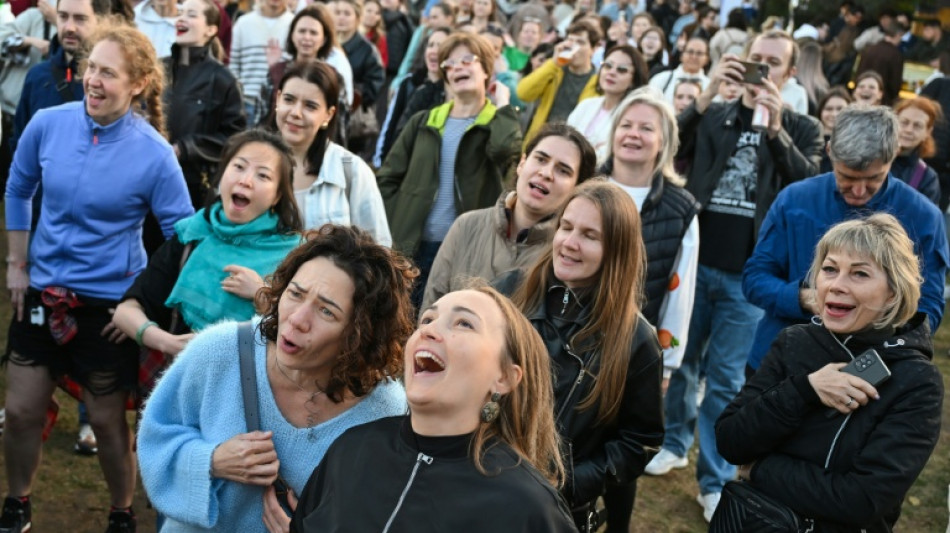
Russians join street choirs to sing away sorrows -- or show dissent / Photo: Igor IVANKO - AFP
When 20-year-old Muscovite Artyom Allabut stumbled on videos of Russian street choirs, he got goosebumps and decided to join one, finding a sense of togetherness and escapism.
At a time when public gatherings in Russia are strictly regulated and dissenting voices silenced, street choirs have been springing up across the country.
Some offer an avowedly apolitical opportunity to come together and sing -- but others have come to be seen as a rare arena to voice criticism.
"When you're constantly anxious and there's always something going on in the world, you can really come here to unwind, sing, and just lose yourself in the moment," Allabut, a medical student, told AFP.
Russia's full-scale offensive in Ukraine, launched in February 2022, has left hundreds of thousands of soldiers and civilians dead.
Moscow -- as well as regions far from Ukraine -- have been the target of Ukrainian drones for several months in counter-attacks to Russia's daily bombardments.
Refineries and warehouses belonging to e-commerce giants have been hit and civilians killed.
And despite Vladimir Putin's denials, rumours swirl of a new mobilisation.
Nearly half of Russians that live in big cities reported depression and 36 percent said they suffered from acute anxiety, according to a September survey by the Russian Academy of Sciences published in local media.
Alongside Artyom and hundreds of other Muscovites dressed in their Sunday best, 37-year-old Ekaterina was waiting for the choir performance to begin.
She kept glancing at a large screen where the lyrics to the first song were about to appear.
"We can legally let off steam together in the city, and it'll be seen as perfectly normal," she said, calling it "a form of therapy".
"People actually do turn to psychologists quite often. But for the most part, of course, they don't talk about it or show it openly," Ekaterina, who works as a family psychologist on crisis hotlines, said.
- 'That's my freedom' -
The first of the new wave of street choirs, "Choir for the Whole Courtyard", was founded in Saint Petersburg two years ago by Ekaterina Mitrofanova.
The idea came to her out of "a strong desire to come together and be with other people".
"People need other people," the 35-year-old told AFP.
"I can use my voice across different ranges: I can start singing softly and then open up to sing at full volume, and that's my freedom -- and that's why I feel so good," she said, stressing her choir was strictly apolitical.
Street choirs emerged in about a dozen other cities this summer, from Arkhangelsk in the north to Omsk in Siberia.
The performances are not limited to "courtyards", but also take place in parks, public squares and abandoned factories.
Admission is often free, or around 1,000 roubles ($11).
In a spacious courtyard near Three Stations Square, hundreds of Muscovites turned up to take part in a recent performance.
"I am free, I have forgotten what fear means," Nastya Fiodorova sang -- belting out the chorus of "I am Free", a famous 1990s Russian rock anthem, while filming the emotional faces around her.
The 28-year-old comes to sing every Saturday "to feel among kindred spirits".
"This is one of the few places where you can be in a crowd of like-minded people, unite, and truly feel a shared sense of support," she told AFP.
"We don't need to link it to what's happening around us. We just meet up and sing," Fiodorova said.
- 'Among your own kind' -
Some choirs have become a form of thinly-veiled protest.
Last summer, in Saint Petersburg and Novosibirsk, passers-by and musicians put on a show featuring the works of composers classified as "foreign agents" and now banned.
And in late August, 24-year-old student Alexandra was among hundreds who sang children's songs outside a court that had barred the anti-war Yabloko party from taking part in parliamentary elections.
Dozens of young people were detained.
Vladimir Putin's United Russia party went on to secure a sweeping majority in a vote which featured no genuine opposition.
But for Alexandra, the choirs help her find a much-needed sense of community.
"When you sing, you feel like you're among your own kind," she told AFP.
M.Michel--JdCdC