At Liberty: Early Philadelphia Life Explored in New Penn Art Exhibition
A new exhibition at the University of Pennsylvania offers a visual exploration of daily life in Philadelphia during the era of the American Revolution. Through 41 works, including paintings by John Krimmel and N.C. Wyeth, 'At Liberty' examines the diverse communities that built the city alongside founding figures like Benjamin Franklin.
An art exhibition at the University of Pennsylvania titled "At Liberty: Life in the City of Brotherly Love During the Early Republic" provides a detailed look at the social fabric of Philadelphia in the decades surrounding the American Revolution. Running through Dec. 13 at the Arthur Ross Gallery, the free public display features 41 works that juxtapose portraits of founding fathers with scenes of everyday labor and leisure.
Gwendolyn DuBois Shaw, the James and Nan Wagner Farquhar Professor of History of Art at Penn and the exhibition’s curator, stated that her goal was to examine the city not only through its famous leaders but also through the "everyday Philadelphian" who built and maintained it. The show highlights the diversity of the population during the founders' era, including European immigrants and Black residents who contributed to the city's identity.
While Benjamin Franklin is a central figure due to his role in founding the institution that evolved into Penn, the exhibition avoids presenting him solely as a static icon. It includes "Apotheosis of Franklin," a 1926 mural by N.C. Wyeth, which depicts Franklin in front of Independence Hall surrounded by George Washington, Thomas Jefferson, John Adams, and other historical figures. Although the original 30-by-16-foot mural resides in Penn’s Hill College House and could not be moved to the gallery, a half-size copy looms over the exhibit space.
The display also contrasts different representations of Franklin. A portrait by Scottish artist David Martin from 1767 shows him in a sophisticated setting with a powdered wig and a bust of Sir Isaac Newton, an image Shaw noted was Franklin’s favorite self-representation. This is set against works that cultivate his "everyman" persona, such as pieces by Charles Wilson Peale.
A significant portion of the exhibition focuses on the work of German-born artist John Lewis Krimmel, who became a naturalized American citizen before dying in Philadelphia at age 35. Shaw described Krimmel as an "underrated" visual reporter who sought to document the mixed communities he encountered.
Among the first works visitors encounter is Krimmel’s 1813 painting "Quilting Frolic." The piece depicts a lively domestic scene where people appear to have finished making a quilt, accompanied by music from a Black fiddler and food brought by a young Black servant girl. A portrait of George Washington hangs on the wall behind them, near battle prints from the War of 1812. Shaw called it one of the first genre scenes in American art, noting its charm and complexity as a mix of figure painting, still life, and a "wunderkammer" or wonder room filled with marvelous objects.
Krimmel’s interest in documenting Philadelphia’s working classes is further evident in his watercolor "Nightlife in Philadelphia — an Oyster Barrow in front of the Chestnut Street Theater." Loaned from the Metropolitan Museum of Art, the drawing shows men buying oysters and drinks from a cart operated by a Black man and a white woman, illustrating entrepreneurial partnerships across racial lines. Another work, "Worldly Folks: Questioning Chimney Sweeps and Their Master Before Christ Church," portrays a Black chimney sweep with his charges, highlighting an occupation available to Black men despite the dangerous conditions for the children who performed the cleaning.
Shaw emphasized that Krimmel’s work serves as a form of visual reportage, aiming to share the truth of Philadelphia’s middle and working classes with audiences abroad. "He’s thinking about the community that he’s encountered that he’s becoming a part of," Shaw said. "How am I going to show these mixed communities that I’m encountering?"
The exhibition draws from multiple sources: approximately half the works come from the Penn Art Collection and Pennsylvania Hospital, while others are on loan from the Pennsylvania Academy of Fine Arts, the Winterthur Museum in Delaware, the Metropolitan Museum of New York, and private collections.
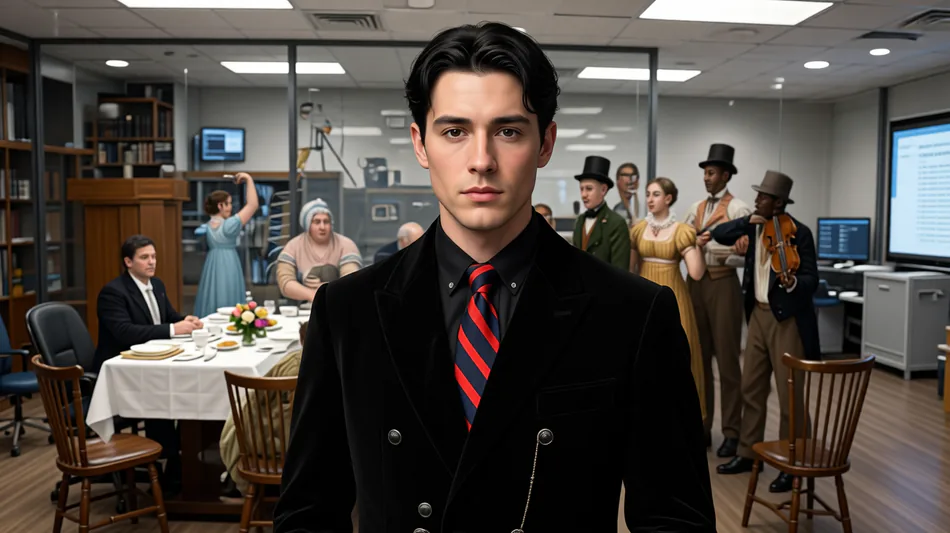
A dedicated "little room" within the gallery features videos produced by Drexel University’s public history and technology program. This space functions as a mini-library for related publications and demonstrates virtual reality headsets used to explore the exhibition's themes.
Shaw, who has been with Penn since 2005, noted that the show brings together a decade of collaborative work with colleagues at Temple and Drexel universities. She hopes "At Liberty" will inspire students to engage with historical resources and understand how contemporary technology can aid in researching the past. The gallery will be closed from Nov. 25 to Nov. 29.
B.Bertrand--JdCdC