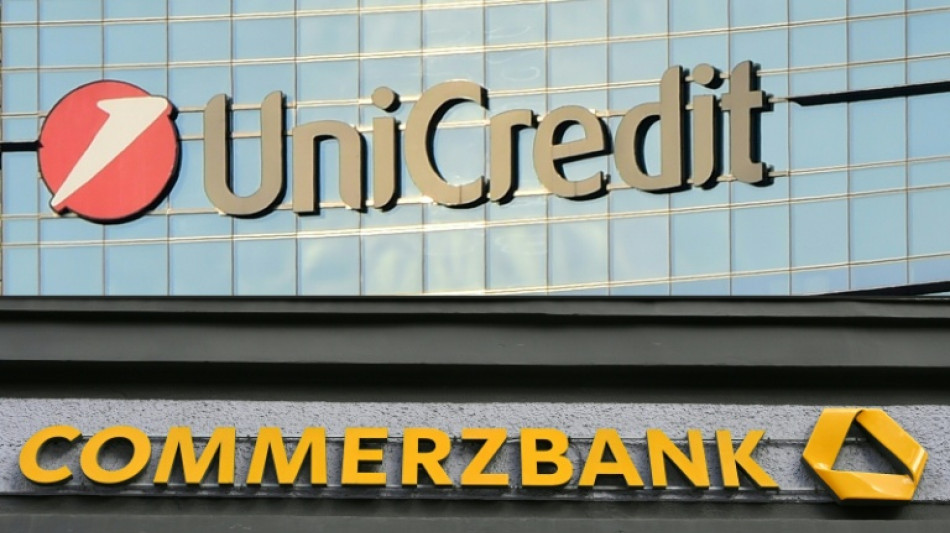
European bank battle heats up as UniCredit swoops for Commerzbank / Photo: GIUSEPPE CACACE, John MACDOUGALL - AFP/File
Italian bank UniCredit on Monday made a 35-billion-euro ($40 billion) takeover offer for Commerzbank, sparking fury from Berlin and a defiant vow from the German lender to defend its independence.
While stressing that it did not expect to take full control, UniCredit said it would raise its stake in Germany's second-biggest bank to more than 30 percent, triggering a mandatory takeover offer under German law.
It marks a sharp escalation in a saga which has sparked uproar in Germany, and the finance ministry in Berlin swifty responded that any "hostile takeover" of the systemically important bank would be "unacceptable."
UniCredit boss Andrea Orcel said earlier on Monday that the drama, which began in 2024 when the Italian lender acquired a substantial stake in Commerzbank, had become a distraction for both banks and it was time to act.
Italy's second-biggest bank decided to make the move "because we felt that to continue to stall was a suboptimal situation for both," he told analysts on a call.
"This offer was a neat way to open dialogue and to try to put the ball back in centre court," he added.
"You can imagine the outcome I eventually hope for -- but it doesn't need to be that."
Commerzbank CEO Bettina Orlopp, however, noted the approach was "not coordinated with us", and reiterated that she was determined Commerzbank should remain independent.
"We are convinced of the strength and potential of our strategy, which focuses on independence and profitable growth," she said.
She also suggested the offer as it stands was too low, saying that it "contains no premium for our shareholders".
UniCredit offered a premium of four percent on Friday's closing share price for Commerzbank, but the German lender's shares soared 6.8 percent on Monday morning following the takeover offer.
- Unwelcome advances -
Announcing its offer to acquire all Commerzbank's shares, UniCredit said it expected to gain a stake of more than 30 percent "without reaching control".
"This would both remove the need for UniCredit to continuously adjust its stake to remain under the 30-percent threshold and an ability to increase its stake freely," it added.
UniCredit currently has a direct stake of around 26 percent in Commerzbank and controls an additional some four percent through financial derivatives.
Berlin still has a 12.1-percent stake in Commerzbank, the legacy of a 2008 bailout during the global financial crisis.
Known for financing Germany's prized network of small- and medium-sized industrial champions, Commerzbank is dear to many Germans, and the prospect of an Italian takeover has been far from welcome.
Commerzbank staff have also opposed the move, and union Verdi warned that the German lender could be "dismantled" in the event of takeover.
"An independent Commerzbank is the best guarantee of secure jobs and a solid future for both institutions," union official Christoph Schmitz-Dethlefsen said.
Some employees dressed up as Gallic warriors fighting Roman invaders outside Commerzbank's shareholder meeting last May.
The Frankfurt-based firm has also raised dividends and cut thousands of jobs in an effort to boost its share price and make any takeover more expensive.
But some European policymakers have made more supportive noises about a potential takeover as they seek to unify the region's fragmented financial services sector.
Asked in 2024 about the saga, ECB chief Christine Lagarde said that cross-border banking mergers were "desirable" to allow Europe's lenders to compete with their bigger rivals, particularly in the United States.
L.Leclerc--JdCdC