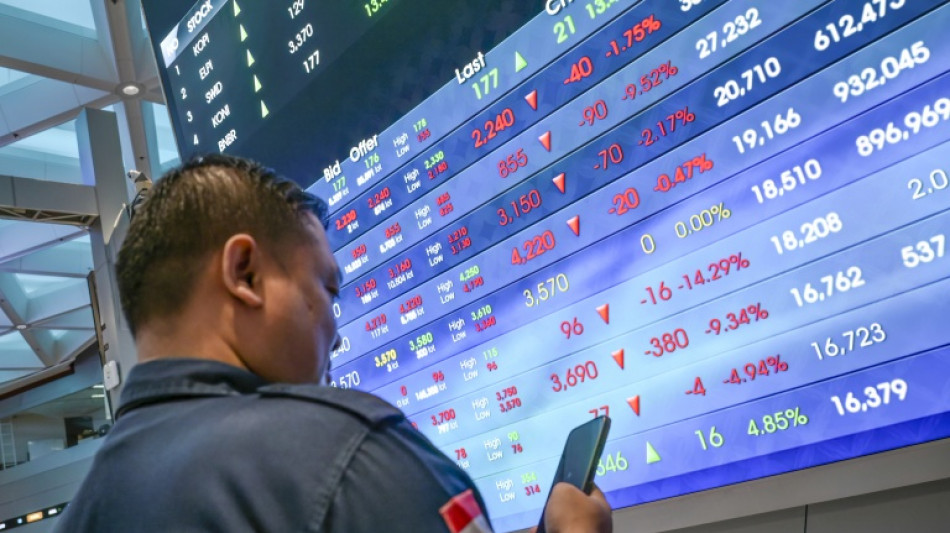
Indonesian stocks dive 11% as MSCI weighs market reclassification / Photo: BAY ISMOYO - AFP
Indonesian stocks plunged more than 11 percent Friday as index compiler MSCI said it was "no longer appropriate" to maintain the country's emerging-market status, fuelling fears of an exodus of foreign investment.
The US firm said earlier this year that investors had raised concerns about "ongoing opacity in shareholding structures" as well as co-ordinated trading behaviour that affected price information.
Authorities in Jakarta said in April they had completed reforms, hoping to avoid the downgrade, which could deal a blow to government efforts to kickstart Southeast Asia's biggest economy, and have a significant impact on investment decisions.
But on Friday MSCI said investors had indicated the "sufficient progress has not been observed consistently across the Indonesian equity market".
"Despite the announced reforms, significant concerns remain around market dysfunction, including continued suspected coordinated trading behaviour and lack of evidence of meaningful enforcement.
"Accordingly, MSCI considers Indonesia's continued classification as an Emerging Market no longer appropriate and is launching a consultation on a proposal to reclassify Indonesia as a Standalone Market."
"A reclassification to Frontier Markets would not properly recognise the depth of the market problems," it said.
A standalone classification could force investment funds tracking the MSCI's emerging market indexes to sell Indonesian holdings.
Argentina, Lebanon and Palestine are among the markets with the designation, with none in Asia, according to Bloomberg.
The Jakarta Composite Index collapsed eight percent at the open, sparking a trading halt. When trading resumed it was down 11.1 percent, its heaviest fall since early 1998 and sitting at its lowest level since 2020.
The index has now fallen more than 40 percent since the start of the year.
- Rupiah weakens -
In reaction to the news, the Indonesia Stock Exchange (IDX) said it "respects MSCI's independence in assessing and determining market classification based on its proprietary methodology".
"However, considering the various progress and reform measures that have been taken, the IDX will request further clarification from MSCI regarding the basis for the considerations and assessments behind this announcement.
"We also need to emphasise that this MSCI announcement is still part of the consultation process, with input being accepted until April 30, 2027, and does not constitute a final decision."
The rupiah dropped about 0.8 percent against the dollar to sit at around around 18,060, having hit 18,209 in June, its weakest level on record.
Erwin Gunawan Hutapea, the Indonesian central bank's head of monetary management and securities, said the bank would take action to ensure stability of the rupiah, which had already tumbled around eight percent this year to a record low.
"Amid rising global risk-off sentiment, which has driven US dollar strengthening and put pressure on domestic financial markets, capital outflows from domestic portfolio assets are expected to continue.
"Bank Indonesia is committed to maintaining a presence in the market to uphold Rupiah exchange rate stability in line with its fundamentals and to ensure that market mechanisms function properly."
The central bank had carried out several rate hikes earlier in the year to shore up the rupiah, after it came under pressure over the state of Southeast Asia's biggest economy.
The bank is due to hold its next monetary policy meeting on Wednesday.
New York-based MSCI produces international indexes used by investors as a benchmark to balance their portfolios.
It has a significant impact on investment decisions through its flagship emerging markets index, which contains 1,200 companies with a market capitalisation more than $10 trillion.
Fund managers worldwide keep a close eye on what countries are included or excluded in MSCI's indexes as that can trigger adjustments to their portfolios.
B.Barbier--JdCdC