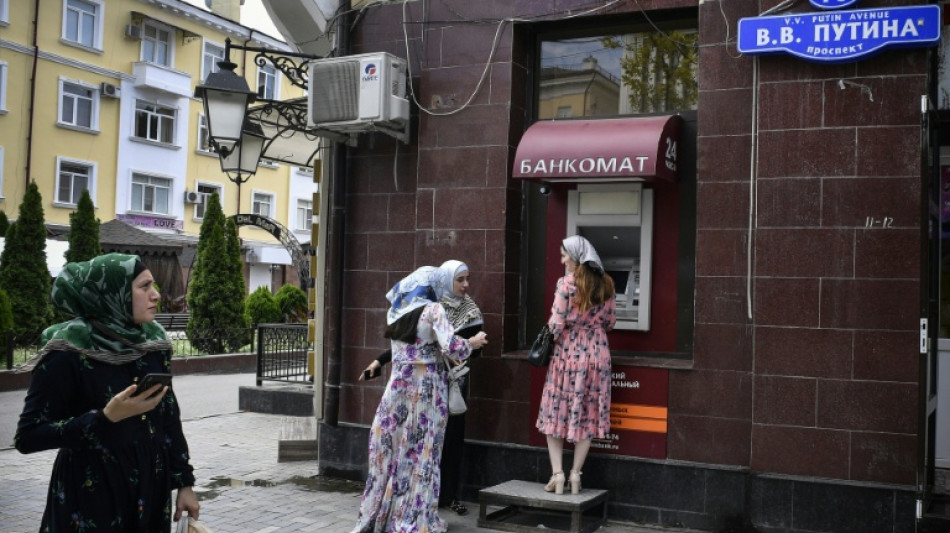
Amid Ukraine war fallout, fearful Chechen women seek escape route / Photo: Alexander NEMENOV - AFP
Facing what activists say is a hardening of repression inside Chechnya amid Russia's invasion of Ukraine, Asil and Aishat, both young women, recently fled their violent families in search of safety.
Only Asil is alive today.
The Muslim-majority region in the North Caucasus mountains is one of the most conservative and closed in Russia. Women have few rights and strict family codes and clan ties overrule the written law.
Strongman leader Ramzan Kadyrov is a crucial backer of President Vladimir Putin, pledging to keep the restive region loyal to Moscow in exchange for permission to run it as he sees fit.
He has sent thousands of men to fight on the front in Ukraine -- a war that rights groups say has worsened condition for women in Chechnya.
Asil, whose name has been changed for security reasons, and Aishat said they were beaten, insulted, and humiliated by relatives before they fled. When they tried to resist, they were accused of being possessed by the devil.
"The reasons for everything are the 'sheitan'," Asil told AFP, referring to the Arabic word for devil.
In an interview with AFP last year after escaping, Asil said she still felt an "animal fear" of being tracked down, forcibly returned to Chechnya and killed because, in the eyes of her relatives, she had dishonoured the family.
There have been several cases of Chechens who fled suffering that fate.
- 'Russian manners' -
Aishat Baimuradova, 23, was found dead in an apartment in Yerevan, Armenia in October after escaping Chechnya.
Police launched a murder investigation, but the two suspects have not been apprehended.
Before her death, Aishat had criticised Kadyrov's ultraconservative Islamic policies under which women face strict controls on what they can wear, their education, work and movement.
The Chechen leader in 2009 publicly warned that any woman who behaves promiscuously could be "killed by her brother".
Aishat said she was abused for years.
A friend, speaking to AFP on condition of anonymity, said Aishat had been raped as a child by her father and grandfather, and then by her husband, whom she married very young and had a child with.
The North Caucasus SOS (NCSOS) rights group helped Aishat to leave. After her death, it published audio messages from her recounting abuse by her husband.
Aishat said he beat her and called her a "whore".
"I told him: why did you marry a woman if you hate women? Marry a man and divorce me," she said in a low, tired voice.
The message was recorded while she was still in Chechnya, before fleeing in early 2025.
After escaping, Aishat no longer wanted to keep a low profile.
Her hair newly dyed red and styled into a pixie cut, Aishat began posting workout sessions and showing off her muscular arms on social media.
Pro-Kadyrov Chechens quickly made threats, accusing her of "Russifying", abandoning her Chechen dress and behaving immodestly.
"They condemn me for my supposed Russian manners, but they kiss Russia's ass by supporting its war against Ukraine and participating in it. Where's the logic?" she posted on Telegram in September.
Kadyrov says the tens of thousands of Chechen fighters serving in Russia's army are fulfilling their "sacred duty".
Many were attracted by high salaries and bonuses, but the Memorial rights group said a "large number" were essentially forced to fight in Ukraine. The alternative is paying a large bribe or facing reprisal.
- 'State within a state' -
Kadyrov, who has ruled Chechnya since 2007, says that tight security is necessary to stamp out the possibility of a jihadist resurgence.
Two wars against Russia in the 1990s killed tens of thousands and saw cities, including the capital Grozny, razed by Moscow's army.
In exchange for suppressing dissent, the Kremlin gave Kadyrov -- whose father switched sides during one of the conflicts and was later assassinated -- near-total control of Chechnya.
Rights groups describe the mountainous region of 1.5 million people as a "state within a state".
Independent reporting from inside is virtually impossible.
Over the past 15 years, NGOs have confirmed more than 70 cases of honour killings -- the premeditated murder of an individual, almost always women, judged to have brought shame on a family -- in the Russian Caucasus, most in Chechnya.
Kadyrov denies accusations of human rights violations.
Russia's invasion of Ukraine in February 2022 has worsened the plight of women, David Isteev from NCSOS said.
"We've seen a sharp rise in the number of requests. In fact, it's increased by a rate of dozens," he told AFP.
"It's connected with systemic post-traumatic violence. People are returning from combat zones with PTSD. The wave of violence in the region has grown significantly."
It is virtually impossible for independent groups to work there, while the West's tougher approach to Russia also makes it harder to exfiltrate people, Isteev said.
Asil told AFP the level of fear in Chechnya has intensified with people worrying about being reported for comments about the invasion.
Recalling the "numerous" stories of taxi drivers trying to trap passengers into criticising the offensive to then snitch on them, Asil said she had once been pressed with questions by a driver.
The wrong remark is "enough to be kidnapped and tortured," she whispered.
But Asil knows not everyone supports the war -- she once overheard her father telling relatives the invasion was "unjust" and recalling his own suffering at the hands of the Russian army.
- 'I wish they die' -
AFP met Asil in December in Europe, where she has been offered refuge. Her location is being withheld for her safety.
Asil took selfies in front of a historic monument but she will not post for fear of being tracked down.
She hides her background from strangers and has adopted a Western hairstyle to "blend in".
"It's also an act of defiance, because back home I was forbidden to cut my hair," Asil said.
Over a cup of tea, she spoke of Aishat, whom she had never met.
She seemed like a "strong" person who turned her "immense pain" into rebellion, Asil said.
"She had a sparkle in her, and those who extinguished it, those monsters, -- I wish that they die," she said, slamming her fist on the table.
But Asil still believes there are "good Chechen families" and hopes that one day -- after the war and Kadyrov rule -- women will have more rights.
For now, she focuses on her own little "achievements".
She has a room where she no longer fears being beaten and wants to learn music.
"My life and my time are mine."
N.Nicolas--JdCdC