In Seoul square of protest and history, BTS fans welcome grand comeback / Photo: Jung Yeon-je - AFP
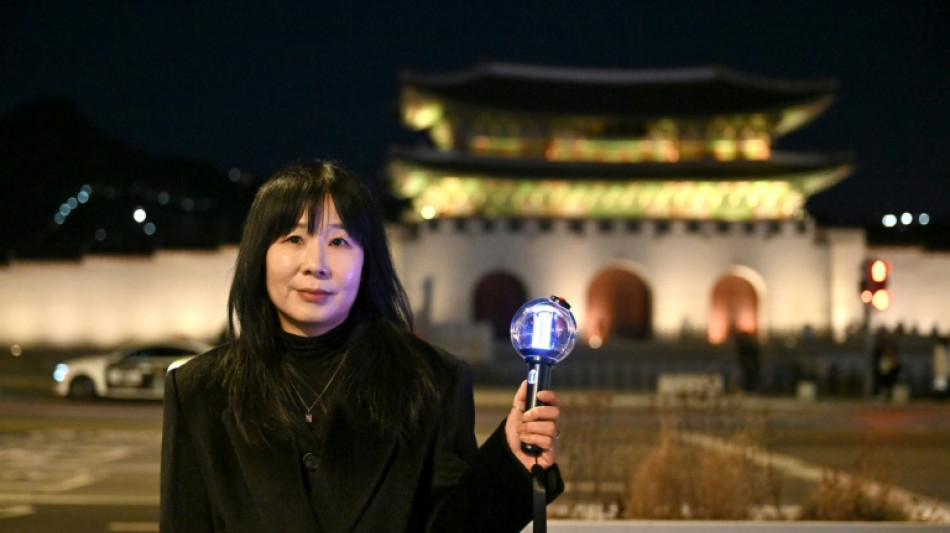
Through months of winter protests in support of South Korean democracy, professor Lee Ji-young clutched her K-pop glowstick -- a small but telling sign of her love for K-pop megastars BTS.
Now the world's biggest boy band is set for a comeback concert on Saturday after a nearly four-year hiatus for the septet to complete military service -- and while the nation went through traumatic times.
"It feels like they've come back to reclaim their rightful place," said Sung Young-rok, 45, a BTS fan and traditional Korean artist, ahead of the open-air concert expected to draw 260,000 people to Seoul.
In late 2024, in a wealthy nation where democracy was thought to be well-anchored, then-president Yoon Suk Yeol shocked the world by trying to declare martial law, sending troops and helicopters to parliament.
His bid failed -- Yoon is now in jail -- but for a few tense hours it was touch-and-go.
And day after day, night after night, hundreds of thousands of South Koreans braved the biting cold to protest against his move.
Like her fellow protestors, Lee -- who has researched BTS's social impact -- rarely let go of her glowstick signifying she is part of BTS's loyal fanbase known as ARMY.
The 55-year-old recalled how their lights shimmered as people marched at night, singing songs to keep up their spirits and warm up in the bitter cold.
"Holding it gave me a sense of protection. I remember feeling that if something dangerous happened, (other ARMY members) would see the glowstick and come help me," she said.
"And when you turn it on at night, it's simply so beautiful. In many ways, it felt like a light that represented us -- something beautiful and strong, a light that reminds you that you are not alone."
- Symbolic location -
The protests were held in the streets around the historic Gyeongbokgung Palace in downtown Seoul, and it's no coincidence that this will be the backdrop for BTS's concert.
South Korea's best-known landmark, built in 1395, has weathered centuries of destruction and restoration.
It has borne witness to hundreds of years of history, from the fall of the Joseon dynasty to the brutal decades of Japanese colonial rule.
In recent years, it has seen mass protests.
The area is a "place that very much served as a national public square, where massive protests have taken place, and to stage a performance there is to try and directly engage with the national consciousness", Keung Yoon Bae, Korean studies professor at the Georgia Institute of Technology, told AFP.
The title of BTS's new album, due to be released on Friday, is in the same vein.
It takes its name from "Arirang", a beloved Korean folk song about longing and separation often described as an unofficial national anthem through war, division and displacement.
Loukia Kyratzoglou, 48, a BTS fan from Greece said the concept resonates for her.
"Years of conflict and socioeconomic change have led to the migration of thousands of Greeks who left their country seeking a better future for their families," she told AFP.
"Much like a migrant who longs to reunite with loved ones and walk again on the sacred ground of their homeland, BTS are returning to their roots after years of separation," she said.
"And ARMY are here to welcome them back."
- Social pain -
It's been arguably a tough time for BTS members in their roughly 18 months of military service.
Four served near the heavily fortified inter-Korean border, which has separated thousands of families since the 1953 Korean War armistice and is known for barbed wire, harsh winters and gruelling training.
Member Jimin slept inside a self-propelled artillery vehicle.
BTS have generally steered clear of politics -- including during the anti-Yoon protests -- but they have not shied away from social issues.
They have spoken openly about mental health and racism, which they have experienced themselves, and donated $1 million to Black Lives Matter in 2019, inspiring fans to match the amount.
Their lyrics have tackled fame, loneliness and depression alongside themes of self-doubt.
Fans have responded with activism of their own, including projects supporting Korean adoptees seeking to reconnect with their birth families, often an emotionally painful and legally complex process.
"In this very complicated political climate, I am proud that they from day one gave full credit to Black hip hop artists who inspired them," Malene Vestergaard, a Korean adoptee and a BTS fan in Denmark, told AFP.
"That they didn't erase their Korean heritage, that they spoke on Asian hate during Covid."
M.Moreau--JdCdC