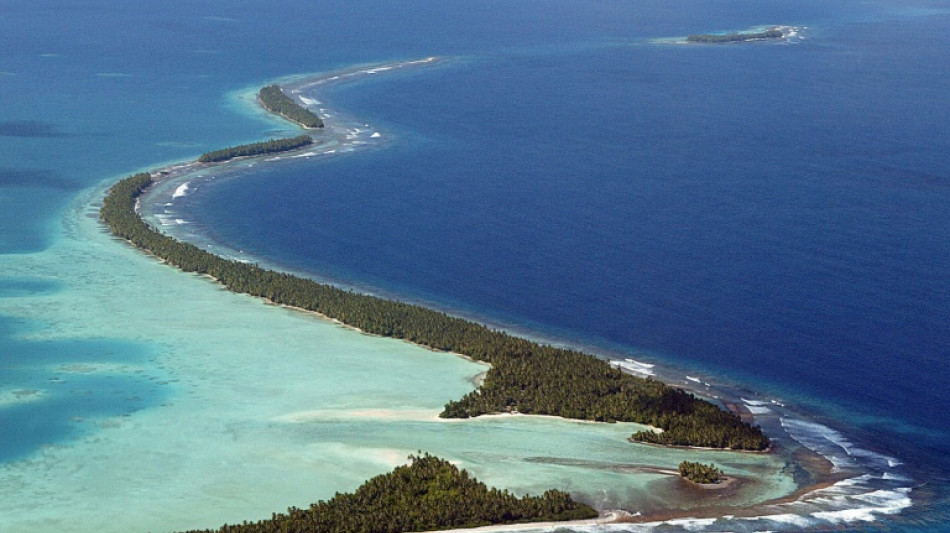
Pacific Islands reject missile test in 'blue continent' / Photo: TORSTEN BLACKWOOD - AFP
Pacific Islands denounced China's ballistic missile test because they say it landed in the heart of their shared "blue continent", politicians and analysts told AFP.
Even Pacific nations indebted to Beijing joined criticism of Monday's submarine-launched ballistic missile test, which reached far into the Pacific Ocean.
The term "Blue continent" is used by Pacific Islands to describe a joint home and shared stewardship of the ocean.
The nuclear-capable missile fitted with a dummy warhead landed somewhere between Nauru, Tuvalu and the Solomon Islands, according to monitors and Pacific officials.
The reported landing spot lies amidst the Pacific islands, but in one of the few patches between them that is not part of an exclusive economic zone (EEZ).
China said the missile test "was not directed at any country" and breached no international law.
But Palau President Surangel Whipps, who will host an annual meeting of Pacific leaders next month, said the missile landed "right between our EEZs".
"We have missiles going right into the heart of the Pacific, unannounced," he said in an interview with AFP.
China's Pacific envoy had days earlier met with the Pacific Islands Forum, after Beijing donated $1 million to the regional bloc, but made no mention of a looming test.
The forum's 18 members see themselves as custodians of 20 percent of the earth's surface, jointly managing fisheries and fighting climate change, within combined EEZs spanning 25 million square kilometres (10 million square miles).
The missile appeared to have landed in a "narrow corridor of international waters" between the surrounding islands' EEZs, said the director of the Pacific Islands program at the Lowy Institute, Oliver Nobetau.
"It begs the question, why couldn't it have been tested to the north of the Pacific Ocean, where there is an expanse of international waters?" he said.
- 'Living fabric' -
A dozen Pacific countries have protested the missile test, including small nations that borrowed from China for their infrastructure, and its closest Pacific security partner, the Solomon Islands.
International maritime law expert Donald Rothwell said while vast EEZs give island states control over ocean resources and coast guard patrols, they don't prohibit missile tests.
Ruth Cross Kwansing, a government minister in Kiribati, said the concept of a "Blue Pacific continent" is fundamental to the region, and is driving the indignation.
"What happens in any part of this ocean vibrates through all of us," she told AFP.
"You have to shift your perspective from a map of dispersed and isolated islands to one where the ocean itself is the living fabric that binds us all together," she said.
"Our seas are not an empty void or a buffer zone between global powers -- they are our estate, our livelihood, and our identity as stewards of the sea."
Anna Naupa, a Pacific security expert at the Australian National University, said despite colonial history fragmenting the map, the idea of a contiguous Pacific continent had re-emerged as island states amplified their collective voice on climate change.
"The Pacific upset is consistent with defending the Ocean of Peace principles," Naupa said, referring to a declaration made by leaders last year that the region stay free of nuclear weapons testing.
The short notice of the test China gave only a handful of countries was seen as disrespectful, she added.
- 'Still haunted' -
Papua New Guinea's Prime Minister James Marape said Monday it should be the "last such missile test conducted in Pacific waters", a message extended not only to China, but all military powers.
The United States conducted 67 nuclear detonations between 1946 and 1958 in the Marshall Islands, and continues to conduct ballistic missile tests there under a defence compact. The Marshall Islands' President Hilda Heine cited the weight of these historical nuclear scars in criticising China's missile.
France and Britain also conducted Pacific nuclear tests prior to 1996.
All missile testing in the region, including China's, will be discussed at next month's Pacific leaders meeting, said Kiribati's Kwansing.
Many Pacific islands are "still haunted by the legacy of World War II fought in the region, as well as the long term effects of nuclear testing", said Nobetau.
"What strikes the fear in Pacific leaders is that it's a clear demonstration of the reach of Chinese capabilities, but also a preview to what kinetic warfare would look like," he said.
L.Richard--JdCdC