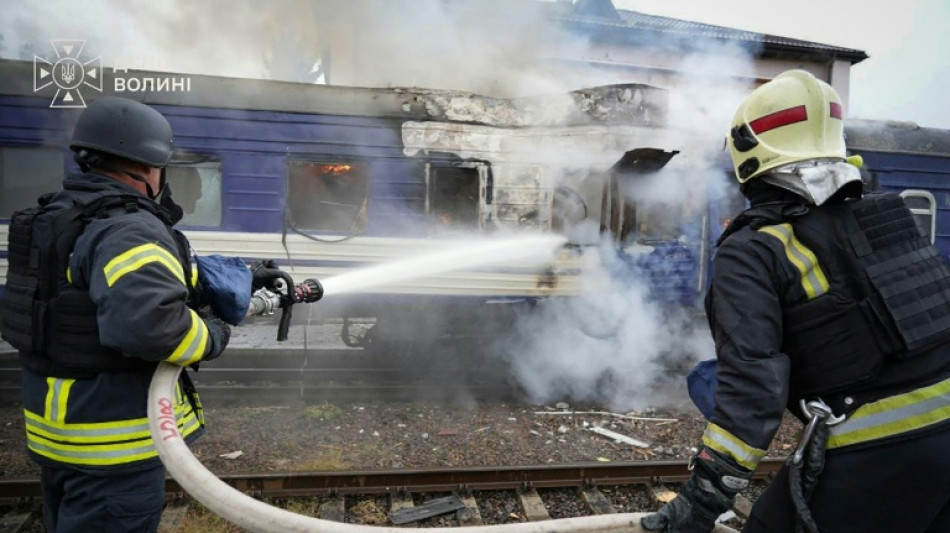
Russia intensifies attacks seeking to intimidate Ukraine, Europe / Photo: Handout - Ukrainian State Emergency Service/AFP
Russia has in recent weeks intensified attacks against civilian targets in Ukraine, seeking to drain Ukrainian morale and intimidate Kyiv's European allies at a time when Moscow believes it has the advantage in weapons production, analysts say.
Capitalising on the depleted stocks of Ukrainian air defence missiles, Russia's own industrial might and the development of jet-powered drones, Moscow has bombarded Ukraine with increasing intensity since the summer, targeting sites of no obvious military significance.
In the latest escalation and in a potential stark message to Europe, Russian strikes at the weekend close to the Polish border hit a Warsaw-bound train near a frontier checkpoint, just after another train passed carrying several European Union officials and British ex-Prime Minister Boris Johnson.
With Ukrainian airspace closed, trains to Poland have been a main route out of the country, widely used by Ukrainians but also the numerous Western dignitaries who travel to Kyiv to show their support for President Volodymyr Zelensky.
Vyacheslav Chaus, the governor of Ukraine's Chernigiv region, said such strikes on civilian infrastructure, including petrol stations, water infrastructure and energy facilities, are a daily occurrence.
The strikes come as Ukraine's harsh winter looms, with temperatures often many degrees below freezing and residents waiting anxiously to see if the infrastructure can survive into 2027.
"We are working every day to improve our resilience, but the problem is that for the past two months, we have been facing an increasing number of jet-powered drones that are much harder to shoot down," Chaus said.
- 'Window of opportunity' -
Faced with a static front line, Russia is attempting to intensify pressure on the rear -- also with a keen eye on elections in Europe where far right parties, sometimes more pro-Moscow, are eyeing gains.
Alexander Gabuev, director of the Berlin-based Carnegie Russia Eurasia Center, said Russia believed the jet-powered drones gave it an edge after a period when Europeans were celebrating some Ukrainian success on the battlefield.
"Russia now has this window of opportunity because the military technology in this war evolves in cycle," he told AFP.
"The jet drones are a weapon of choice for now and they're trying to use that at scale while they have a window where Ukraine doesn't have interceptors that are fast enough to chase them really, and the production numbers really are favouring Russia," he said.
The new Geran drones Russia is using have "unravelled part of the interceptor drone architecture put in place by the Ukrainians", said Stephane Audrand, associate research fellow at the French Institute for International Relations.
Gabuev added the Russian strategy puts "a strain on European resources" and it "gives good ammunition to the populist parties" such as the Alternative for Germany or the National Rally (RN) of French presidential candidate Marine Le Pen.
A top ally of Le Pen earlier this month caused a furore when he declared the RN would "turn off the tap" to Ukraine if it came to power.
- 'Leverage these attacks' -
Europe provides Ukraine with military aid, intelligence and funding for weapons production, as well as joint ventures manufacturing military equipment for Kyiv such as the German-Ukrainian firm Quantum Frontline Industries, which builds drones for Ukraine in Bavaria.
"Ukraine's deep back line is Europe," said Audrand.
This has also manifested itself in intensification of hybrid attacks that Europeans blame on the Kremlin, although Russia consistently denies involvement.
In Germany, authorities accused Russian intelligence of orchestrating an attempted attack using an explosive-laden drone against Ukrainian aircraft at Leipzig airport this summer.
In early September, the Danish intelligence services (PET) issued a public warning that Russian intelligence services were preparing acts of sabotage targeting Denmark's defence industry.
"Denmark is building a defence industrial and technological base from scratch through its contacts in Ukraine," said Audrand, and consequently, Russia is "thinking about sabotaging the factories in Denmark."
The escalation comes some four-and-a-half years into the conflict sparked by Russia's full-scale invasion of its neighbour.
Russia has long sought to push Ukraine into a position where impatience from the administration of US President Donald Trump and European fatigue would force Kyiv into a settlement favourable for Moscow.
Trump's envoys Steve Witkoff and Jared Kushner met President Vladimir Putin in Moscow earlier this month, meeting Zelensky in Kyiv the day after, but with no sign of any breakthrough.
"I am sure that in the context of negotiations, the Russians will try to leverage those attacks and send the signal that 'this thing is getting out of control. So in order to stop it, you just need to put pressure on the Europeans and Kyiv'," said Gabuev.
W.Weber--JdCdC