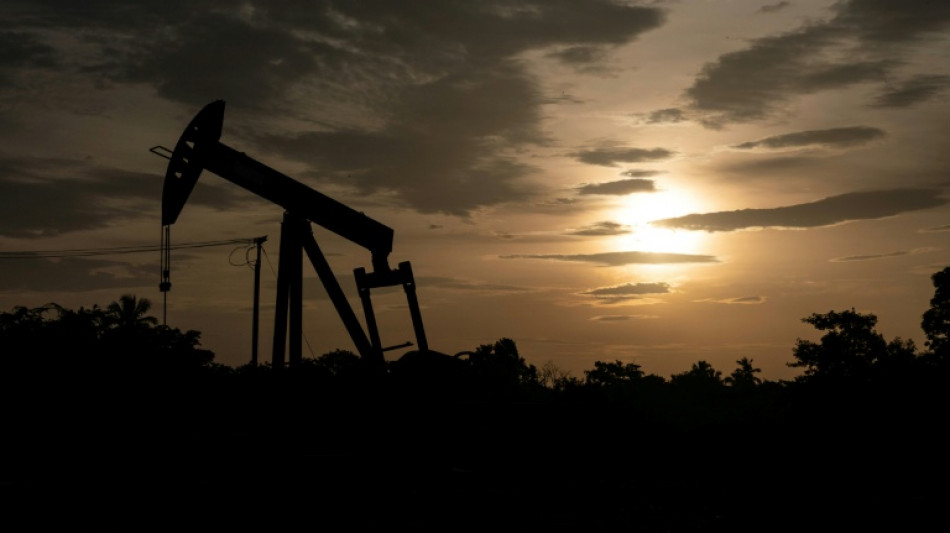
Oil companies close in on Venezuela despite hurdles / Photo: John Chacón - AFP
Foreign oil companies scrambled for a slice of Venezuela's crude at an oil summit in Caracas this week despite years of sanctions, underinvestment and mismanagement that have crippled the once booming industry.
Venezuela sits on the world's largest proven oil reserves, but its current production of one million barrels of crude per day falls far short of the three million it averaged decades ago, with experts attributing the decline to years of corruption and poor management.
The sold-out Venezuela International Oil and Gas Summit in Caracas, which runs until Wednesday, has attracted bosses from companies including European giants Repsol, Siemens, Maurel & Prom, US firm Hunt Oil Company, Qatari producer UCC Holding and Colombia's GeoPark.
"Venezuela is the place to be," Erik Keskula, director of exploration and production at UCC Oil and Gas Holding, said Tuesday.
US President Donald Trump, who wants to take charge of the country's oil industry, has piled pressure on interim leader Delcy Rodriguez, who took power after the United States toppled president Nicolas Maduro in a military raid in January.
Rodriguez has granted Washington access to a huge chunk of the country's crude reserves and signed agreements with foreign companies to look for, produce and export oil and gas.
North American Blue Energy Partners (NABEP), the company at the heart of a massive US-Venezuela deal in August to operate 17 oil fields with proven reserves of about 65 billion barrels, was not present at the summit.
According to a White House report, Washington holds veto power over NABEP's board of directors, the majority of whom must be US citizens.
Critics in both the United States and Venezuela accuse Trump of holding the country to ransom after ousting Maduro and warning that Rodriguez could face a similar fate if she does not succumb to Washington's demands.
Rodriguez insists Venezuela retains control of its oil.
- 'Work to be done' -
Organizers said hundreds of names were on a waiting list for the event, highlighting the industry buzz around Venezuela's oil sector re-opening after years of state control.
Venezuela's government, which remains under control of the ruling Chavista movement -- named after late socialist firebrand Hugo Chavez -- blames years of tough US sanctions for crippling the industry.
In 2019, during his first term in office, Trump imposed an embargo on Venezuelan oil in response to 2018 elections that were already marred by fraud allegations.
Venezuela's state-owned PDVSA oil giant was in freefall at the time, beset by corruption scandals, mismanagement and a crippling lack of investment.
Oil output buckled under the weight of the sanctions.
"Real work remains on transparency, on governance, on ensuring that every dollar of revenue serves its intended purpose," said Michael Garcia, deputy chief of mission at the US Embassy in Caracas.
"But the direction is unmistakable," he said. "Where there was stagnation, there is now investment."
Venezuela's chronic electricity shortage was a key theme at the event, which was itself hit by two power cuts.
Hunter Hunt, CEO of Hunt Energy Holdings, said he was confident that such "infrastructural weaknesses" could be solved "quite quickly."
- 'Ambitious goal' -
Companies already operating in Venezuela are pushing to boost production.
Ludwing Mercado, Repsol's operations manager for Venezuela, said the company aimed to increase oil production by 50 percent in its oil fields in the country's west.
When French firm Maurel & Prom secured a US license to operate in Venezuela this year -- along with BP, Chevron, Eni, Repsol and Shell -- bosses were "perhaps overly optimistic at the start," deputy general manager Cesar Alvarez said.
"We drew up an action plan, but we ran up against reality and [had to] delay certain activities," he said.
Despite the challenges, Maurel & Prom expects to close the year with an output of 23,000 barrels per day.
M.Marchand--JdCdC