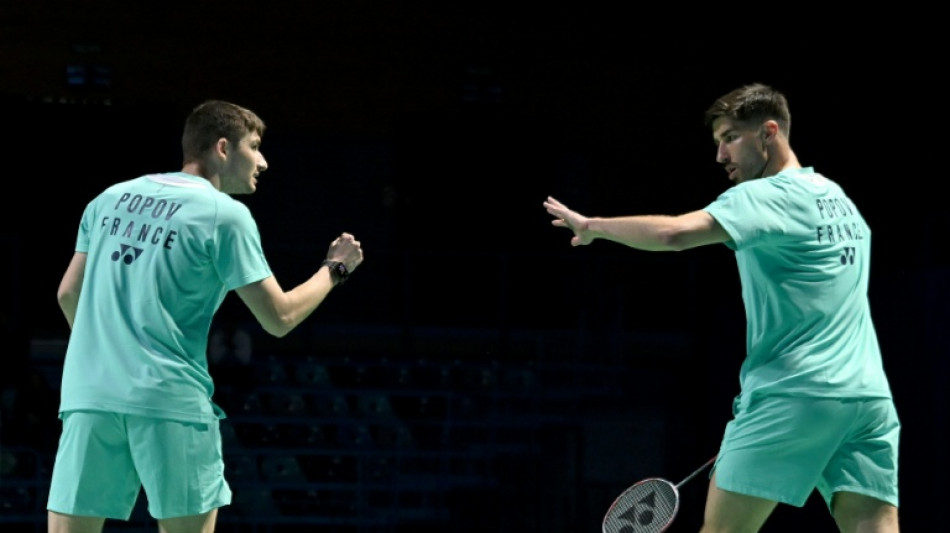
Badminton looks to future with 'evolution and innovation' / Photo: Cristina Quicler - AFP
Synthetic shuttlecocks, shorter games and a new generation of stars are all part of the "evolution" of badminton, a top official told AFP, saying the sport can't afford to sit still.
Traditionalists hit out after the Badminton World Federation said that from January 2027 it will adjust the scoring system, partly with an eye on the next generation of fans.
Currently matches are the best of three games, with the winner of each the first to 21 points. That will change to the first to 15.
Also last month, the BWF said it will trial synthetic shuttlecocks at lower-grade tournaments with a view to potentially using them at elite level.
Days later -- in an unrelated move -- double Olympic champion Viktor Axelsen retired aged 32, leaving a hole at the top of the men's game.
BWF secretary general Thomas Lund told AFP that badminton was well placed to thrive as it attempts to build on the immense popularity it already enjoys in Asia.
Members overwhelmingly approved 15-point games, but Lund conceded: "Of course there are some who have doubts about what that will mean for the game.
"I would say most of the traditionalists or sceptical voices in our community are -- as I see it -- the ones who are afraid that the sport will change.
"I would say this is rather seen as a tweak to the sporting aspects to the scoring system and the game... this is very much in line with how we see the game being played today, the DNA, how the game will evolve," Lund added.
It was also about "the welfare of players in terms of recovery" and making it more appealing to fans and broadcasters, he said.
- Ruffled feathers -
Part of any sport's allure is having big stars and badminton lost one in Lund's fellow Dane Axelsen.
Spain's 2016 Olympic champion Carolina Marin also left the sport in March at the same age after a long struggle with a knee injury.
Before them, the rivalry between China's Lin Dan and Lee Chong Wei of Malaysia captivated and even transcended the sport until 2018.
Lund dismissed concerns that Axelsen's retirement and the lack of a rivalry akin to the Lin-Lee storyline hurts badminton.
"I've heard this for 40 years," he said.
"The sport that we sometimes compare ourselves with is tennis, and everybody was afraid of what will happen when (Roger) Federer and (Rafael) Nadal disappeared.
"I'm not sure people think about that now because others come up and play fantastic tennis, and now the same will happen with badminton," he said, pointing to how France last weekend reached the final of the Thomas Cup men's team event for the first time, losing to superpower China.
Another recent announcement which raised eyebrows among traditionalists concerns trying out synthetic shuttlecocks, amid concerns about costs and a shortage of duck and goose feathers.
"We believe that should be pushed and pursued," Lund said, adding it was "coming step-by-step".
The BWF said in April it will try synthetic shuttlecocks at selected events including junior international tournaments.
Asked if he saw a day when all of badminton uses synthetic shuttlecocks, Lund said: "I do hope at the highest level that we will be able to have a quality (synthetic) shuttle we can then use more and more across the tours and the major championships over the years."
Lund said that using synthetic shuttlecocks is also to do with making badminton more affordable at grassroots -- the BWF says more than 300 million people play globally.
"It's important that these evolutions and innovations are done," he said.
L.Lefebvre--JdCdC