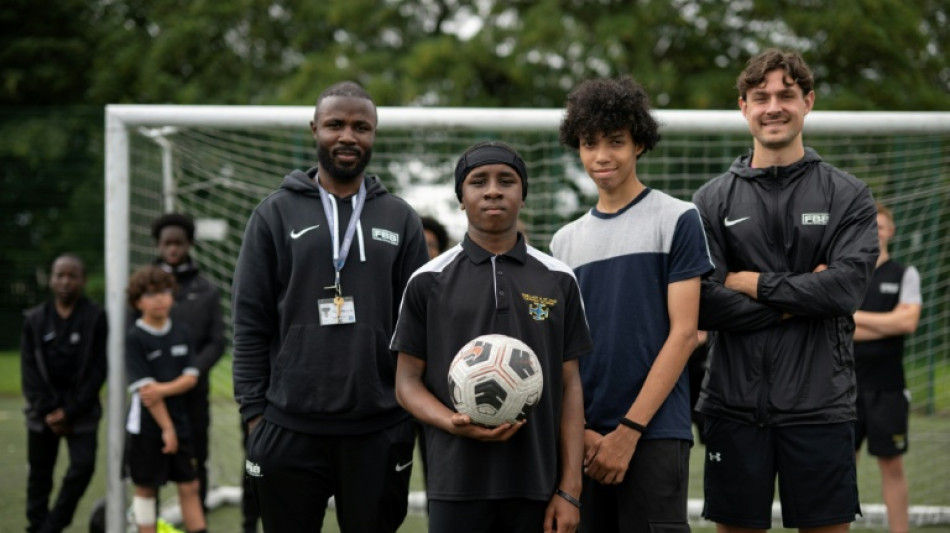
UK schools, mentors team up to rescue 'lost boys' with football / Photo: Oli SCARFF - AFP
A pioneering project in UK schools has been harnessing the power of trusted mentors and a love of football to tackle what researchers call the "Lost Boys" crisis.
Thousands of adolescent boys and young men lacking positive male role models and facing worse life outcomes than girls have been taking part in the scheme across the country.
Kaziah Cameron, 14, said he has never been comfortable around other boys, tending to withdraw, feeling "unable to communicate".
But for almost two years now, the teen with smiling eyes has been receiving extra help.
Every week, on top of his usual lessons, he attends a module on "socio-emotional" development taught by two educators, Ezekiel Agyemang and Matt Bishop.
The two men in their late 20s discuss male brain development and emotions with groups of students aged 12 to 14.
In an era of toxic ideas about masculinity spread by online influencers, they aim to "break down cliches like the idea that men shouldn't cry or show vulnerability," said Agyemang.
"Addressing vulnerability, even fragility -- two feelings we can all go through -- also serves to bring the issue of masculinism into the discussion", added Bishop.
The sessions take place at Our Lady and St Chad Catholic Academy in Wolverhampton, a state secondary school, northwest of Birmingham, as part of a programme run by a charity called Football Beyond Borders (FBB).
The charity, launched in 2014, says it works with "young people from areas of socio-economic disadvantage who are passionate about football but disengaged at school".
The aim is "to help them finish school with the skills and grades to make a successful transition into adulthood".
- 'Bottled up emotions' -
Teachers recommend which students should attend, said Bishop.
As part of the bonding process, after group discussions the boys shed their uniforms and rush outside for a game of football with their mentors.
In Wolverhampton, whose football club is known as Wolves, this is the students' favourite moment.
The programme "helped me open up ... because I didn't really like talking to people. I just kept all my emotions bottled up inside of me," Cameron said.
Fabian Myers, 14, said he liked "a group of boys being around ... men who guide us and stuff. It makes it a bit more comfortable".
He acknowledged his "idea of a man" was a "bit mixed because of the internet".
Faced with the challenges posed by the growing power of male influencers such as Andrew Tate or Harrison Sullivan, also known as HSTikkyTokky, Football Beyond Borders has switched focus.
In July 2025 they launched the "Lost Boys Taskforce" to deal with "a crisis: a lost generation of young boys and men adrift without trusted adult role models".
They cite figures that the "percentage of young men aged 16-24 not in education, employment, or training has surged by 40%, compared to a 7% increase for young women".
- 'Misbehaving' -
This task force's coalition of stakeholders aims to unite those from different sectors including the world of football and education and is headed by Paul Barber, chief executive of the Brighton & Hove Albion football club in southern England.
"Studies suggest that the discomfort many boys experience during adolescence first becomes visible through school dropout," said FBB co-founder Jack Reynolds.
"It is also at this very point that many of them are in search of male role models."
And these boys are likely to encounter influencers who spout extreme misogynistic views, he warned.
"If we are talking about lost boys and a crisis of masculinity, the focus has to be on how we can create and train trusted adults to increase ... the quality of relationships which teenage boys have at that critical adolescent period when they are working out what kind of a man they want to grow up to be," Reynolds said.
Football star Gareth Southgate, the former manager of the England men's team, has long warned of a generation of young men who feel "isolated", recently filming a BBC documentary on the issue.
Reynolds' charity, which also runs a similar programme for girls, is active in 60 schools in three English regions -- London, the west Midlands and Greater Manchester in the north -- involving nearly 3,000 pupils.
Football acts as a unifying force.
"I think it makes me behave more better as well, because I was a bit misbehaving," Myers said with a cheeky grin.
B.Bonnet--JdCdC